 E-Paper
 Sign In




Free form facades offer the path to progress for the UAE’s 15-minute cities
Dubai Walk Master Plan opens opportunities for local businesses to cash in
- PUBLISHED: Thu 20 Feb 2025, 10:11 PM


A rapidly growing population, and an aspiration to deliver the highest quality of life are reshaping urban planning in the UAE, experts say.
Spurred by the desire to offer residents the ability to access work, shopping, healthcare, and leisure within a short walk or bike ride from their homes, the country is pushing forward with its vision for 15-minute cities.
Recommended For You


In a region where formidable temperatures often dictate mobility choices, this vision will rely heavily on enclosed, climate-controlled walkways — an idea formalised in the approval of the Dubai Walk Master Plan. This will see the development of a sprawling 6,500km network of pedestrian-friendly corridors, spanning 160 areas across the emirate.
“Bringing this vision to life will require an array of cutting-edge technologies, but few will be more pivotal than free form facades,” said Michael Quinn, Operations Manager, ALEC Facades.
Iconic design has long been a hallmark of the UAE’s architectural identity, with landmarks such as the Louvre Abu Dhabi and the Zayed National Museum demonstrating a fearless embrace of cutting-edge construction techniques. Free form facades stand as the latest evolution of this trend, blending aesthetics and engineering in ways that redefine the form and function of modern urban environments. Utilising 3D modelling, parametric design software, and robotic manufacturing, these facades enable the creation of fluid, organic structures — curves, folds, and intricate geometries that transform functional elements like pedestrian walkways into striking visual statements.
Having hosted COP28 two years ago, there is no doubt that sustainability will be top of mind for all major undertakings in the Emirates — and the Dubai Walk Master Plan will be no excaption. “Building a 6,500 km network of enclosed walkways demands a sustainable approach, where every efficiency gain counts. Free form facades offer an outstanding strength-to-weight ratio, meaning less material is required to achieve structural integrity. Durability is another advantage — these facades can last 60 to 80 years, and once they reach the end of their lifecycle, the steel and glass elements are 100 per cent recyclable,” Quinn said.
Retrofitting is another essential consideration, as the Dubai Walk Master Plan aims to rehabilitate 2,300 km of existing walkways by 2040. “The lightweight nature of free form facades ensures that even paths not originally designed for enclosures can be reinforced without overburdening existing infrastructure. With advanced coatings for UV protection and shading, as well as the ability to incorporate solar panels seamlessly into the design, these facades will enhance energy efficiency while ensuring pedestrian safety and comfort,” Quinn said.
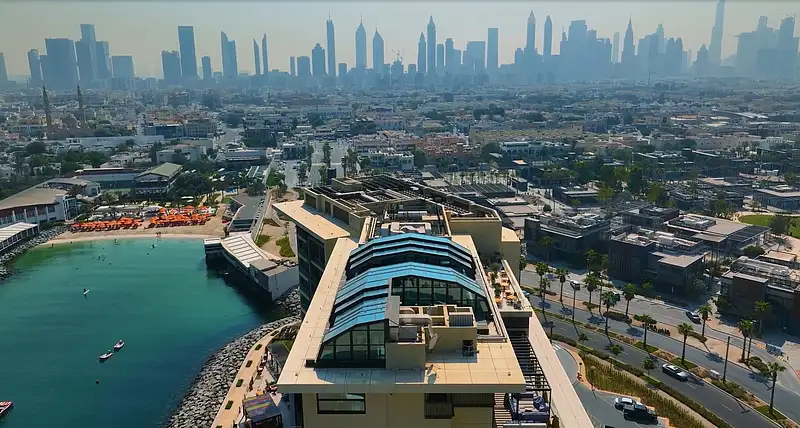
In fact, the aesthetic appeal of these structures is beautifully showcased in projects delivered by ALEC Facades, a subsidiary of ALEC, such as Hyatt Centric Jumeirah Dubai, where stunning glass roofs create an open, airy atmosphere while offering breathtaking views of the sky; and the Sindalah Golf Course at Neom, designed with a freeform approach, emphasising expansive open spaces and an abundance of natural light.
Constructing a vast network of walkways across the UAE’s urban landscape will require precision and efficiency. “In a country where highways seem to appear virtually overnight with little to no disruption to urban commuters, similar agility will be essential for realising this vision. Free form facades are uniquely suited to meet this demand, as they are largely manufactured offsite in highly controlled environments,” Quinn said.

Beyond transforming urban mobility, the UAE’s 15-minute cities will leave a lasting mark on the construction industry. “The large-scale deployment of free form facades will drive demand for local steel and glass manufacturing, supporting the country’s Operation 300bn strategy to boost domestic industrial output. The prefabrication and modular construction sectors, where companies like ALEC Facades have already made significant strides, will continue to thrive as these techniques become integral to major infrastructure projects,” Quinn said.
Additionally, the adoption of 3D modelling, parametric design, and AI-driven simulations will foster growth in digital construction expertise. “These skills will be essential not just for realising 15-minute city paradigms, such as the Dubai Walk Master Plan, but also for shaping the future of construction and urban planning in the region,” Quinn said.
The UAE has never shied away from ambitious urban transformations, and its commitment to 15-minute cities is a testament to its forward-thinking vision. By leveraging free form facades, the country will not only ensure that its cities remain visually stunning, but also pave the way for innovation in construction, sustainability, and manufacturing. “As these pedestrian-friendly corridors take shape, they will stand as more than just infrastructure — they will be enduring symbols of progress, seamlessly blending architectural artistry with functional excellence,” Quinn said.


Associate Editor Somshankar Bandyopadhyay brings more than three decades of experience to the KT newsroom. Currently, he manages the news production of the business section, ensuring that the top economic and business news of the day reaches its readers.