 E-Paper
 Sign In


Trump made history with his Gulf tour: What it means depends on who you ask
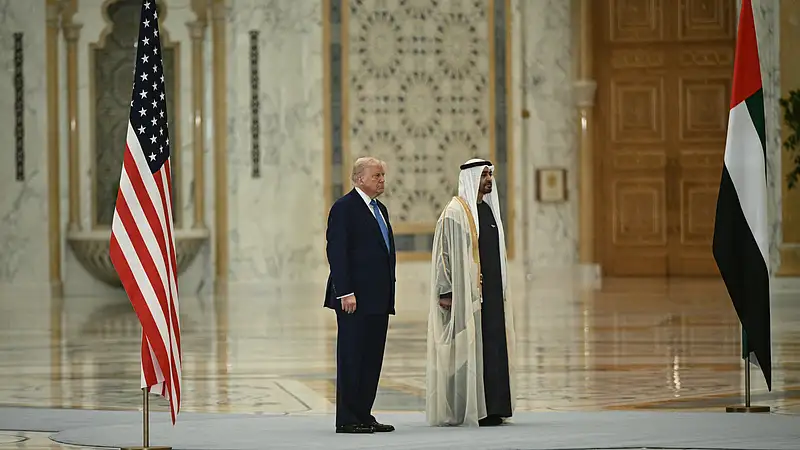
The US President’s decision to travel to the UAE, Saudi Arabia, and Qatar for his first foreign tour in his second term is historic
- PUBLISHED: Fri 16 May 2025, 5:08 PM UPDATED: Mon 2 Jun 2025, 4:55 PM


US President Donald Trump’s tour of the Gulf ends with the complicated narrative of multiple truths, often difficult to digest for a polarised global populace.
First, undeniably, the decision to travel to the UAE, Saudi Arabia, and Qatar for his first foreign tour in his second term is historic. It’s the first visit to the UAE by a US President in more than 17 years. It signals a rapprochement, a fresh attempt at resuming business and harmonious relations with the region.
Recommended For You



The economic benefits include investment commitments of $1.2 trillion (Dh4.4 trillion) from Qatar and $600 billion (Dh2.2 trillion) from Saudi Arabia. The UAE added new $200 billion deals to its March commitment of $1.4 trillion over 10 years.
That’s a staggering total of $3.4 trillion. Observers have said the real total may be much lower.
Trump is “stating a change in focus after a period of disengagement”, and the “sense of excitement to move quickly with opportunities for investments on both sides” was clear, said Imad Al-Abdulqader, partner at global advisory firm DGA-Albright Stonebridge Group.
Trump has made a flurry of diplomatic moves — he’s renewed talks with Iran for peace and a nuclear deal, removed sanctions on Syria whose leader was listed by the US as a terrorist with a $10 million bounty on his head, and removed the condition that Saudi Arabia normalise ties with Israel for US support in building civil nuclear generation capacity.
Perhaps, that’s why the world has taken note.
It’s actively “favouring pragmatism and transactional diplomacy over traditional norms of international conduct,” said Manas Chawla, geopolitical risk expert and CEO and founder
of London Politica.
The shadow of Gaza
The optics of the deals aside, the region’s populace is likely to remain aligned with the Palestinians, haunted by the shadow of unresolved conflict in Gaza.
“Trump’s economic-driven approach to the region is likely to result in a continued de-prioritisation of Palestinian interests, which will have an unpredictable effect on Palestinian militant groups and the rounds of violence which their attacks kick off,” said Chawla.
Yet, Trump’s decision not to include Israel on this trip is a positive sign, said Al-Abdulqader.
Trump, the broker of the Abraham Accords, which normalises the ties between the Gulf nations and Israel, continued to advocate that Saudi Arabia join the likes of UAE and Bahrain in becoming a signatory. Saudi Arabia says that can’t happen without peace for the Palestinians.
“The big prize would have been an official recognition of ties between Saudi Arabia and Israel, but that would require a completely separate track of diplomatic discussions,” said Vasuki Shastry, a senior advisor to geostrategic advisory firm Gatehouse.
Impact of defence and AI deals
The goal of Trump’s tour to three Gulf countries is deals — with a renewed focus on defence and an opening of floodgates on Artificial Intelligence (AI) chips.
Saudi Arabia signed the largest defence sales agreement in history at nearly $142 billion, and the Riyadh-based company DataVolt will invest
$20 billion in AI data centres.
Qatar outlined over $38 billion in potential investments related to air defence and maritime security, while pumping $1 billion in quantum technologies.
Trump’s State Department has also approved the sale of helicopters and F-16 fighter jet parts to the UAE. Abu Dhabi will host a new AI campus, the largest outside the US, and to power such data centres, the US agreed to allow the UAE to import 500,000 of Nvidia’s most advanced AI chips annually.
Shastry said that Gulf countries stand out due to the low electricity prices they offer, critical for the development of large language models in AI.
Experts like Chawla said combining “the Gulf’s financial power with America’s technological edge seems promising, but it’s unclear these investments can truly diversify the region’s economy away from oil”.
Trump’s visit has put a spotlight on the Gulf’s collective investable power and growing influence as a regional convener of peace, with its sovereign wealth funds packing a tremendous punch, said Shastry.
However, both Shastry and Chawla wonder about the future — how the Gulf states will navigate their relationship with the US post Trump’s term and what the real tally of all the investments made by both sides will be.
Deals and global peace aside, the Gulf’s leaders may have felt near catharsis with the hope that this could be the moment the West’s negative perception of the region is reversed. And thus, could this be the Gulf’s moment?
The spanner in the wheels of those possibilities are the ethical concerns surrounding Trump, who may be seeking jobs for America but also has family interests in the Gulf.
They say, “Caesar’s wife must be beyond reproach”, but Caesar (Trump) himself appears to have accepted a plane worth $400 million as a gift (still not formalised). “The transactional nature persists wherever Trump travels, and these Gulf countries have had long-standing investment plans which did not emerge just because a new US President is visiting,” said Shastry.
Could the benefits of the tour beat the ethical concerns around conflicts of interest and security risks? In the absence of intricate details around the implementation of the deals and quid pro quo facts, it may boil down to personal biases and beliefs.