 E-Paper
 Sign In


Commentary: Duterte’s war on drugs should not have come at the cost of innocent lives
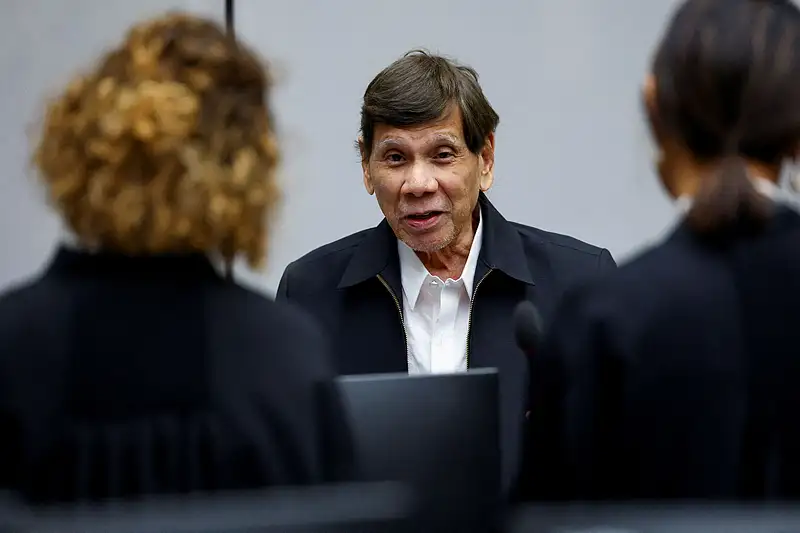
A government has the moral duty to protect society from crime, violence, and social harm. But another moral reality appears the moment innocent people begin dying, especially children
- PUBLISHED: Sat 19 Sept 2026, 6:00 AM
- By:
- Dr Rex Bacarra


The author is a faculty member at Rabdan Academy in the UAE, where he teaches ethics. He holds a Ph.D. in Philosophy (concentration in ethics) and has been recognised as one of the 100 Most Influential Filipinos in the Gulf.
On September 16, former Philippine President Rodrigo Duterte appeared in person before the International Criminal Court (ICC) in The Hague for the first time, during a status conference ahead of his trial scheduled to begin on November 30. The proceedings concern three counts of crimes against humanity arising from allegations connected to his anti-drug campaign. His appearance brought renewed public attention to a case that continues to divide opinion in the Philippines.
Recommended For You




In Manila, families of people killed during the so-called war on drugs gathered to watch the proceedings and renewed their calls for justice and accountability. Supporters and political allies of Duterte, meanwhile, continued to express their support for the former president. The contrasting reactions show that the legal proceedings are unfolding alongside a much larger national conversation about crime, security, justice, state power, and the human cost of fighting drugs. These are questions that reach beyond the courtroom and lead to a deeper ethical dilemma.
Stay up to date with the latest news. Follow KT on WhatsApp Channels.
Many people outside the Philippines fail to fully understand why Duterte became deeply popular to millions despite the controversies surrounding his anti-drug campaign and the ongoing proceedings before the ICC. His support did not emerge from nowhere. It emerged from years of public frustration, fear, and the belief among many Filipinos that criminality and drugs were slowly overwhelming communities while institutions appeared weak and ineffective.
Many ordinary Filipinos were looking at something else entirely. They were looking at fear. Fear in neighborhoods. Fear among parents. Fear of addiction destroying families. Fear that criminals had become stronger than the state itself. And when people become afraid long enough, they begin searching for leaders who appear strong enough to stop the chaos quickly.
This is where ethics becomes difficult. The intention itself was understandable.
Moral duty to protect
A government has the moral duty to protect society. No serious ethical theory argues that a state should simply watch while drugs destroy lives and communities. Law enforcement exists for a reason. Public order matters. Safety matters. Human beings deserve to live without fear.
But another moral reality appears the moment innocent people begin dying. Especially children.
This is where political philosophy introduces one of the darkest ideas in ethics. The dirty hands problem. The idea is simple yet deeply disturbing. Sometimes leaders face situations where every available option carries moral consequences. If they act weakly, innocent people may continue suffering under crime and violence. If they act aggressively, innocent people may die in the process of restoring order.
This is closely related to what criminologists and ethicists call ‘noble cause corruption’. That is, when officers or officials commit acts that would otherwise be considered illegal or unethical because they genuinely believe the outcome justifies the method. It is a dangerous moral territory because it does not begin with bad intentions. It begins with a sincere desire to protect.
Normative ethics helps us understand why this issue remains morally divisive. Different ethical theories approach the problem differently.
Consequentialists such as Jeremy Bentham and John Stuart Mill ask about outcomes. If a harsh anti-drug campaign reduces crime, prevents addiction, and protects millions of citizens, some may argue that the overall social benefit justifies aggressive action. The focus becomes the greatest safety for the greatest number.
A deontologist or non-consequentialist such as Immanuel Kant looks at the action itself. From this perspective, innocent human beings must never become acceptable collateral damage, regardless of the intended outcome. Human dignity and due process are moral duties that should remain protected even during times of fear.
Virtue ethics, associated with Aristotle, asks another question entirely. What kind of society are we becoming through these actions? Are we cultivating justice, wisdom, restraint, and humanity? Or are we slowly normalising anger, cruelty, fear, and emotional numbness?
The difference is that political decisions do not happen once. They shape institutions, police cultures, and public attitudes for years. Leaders are shaping the moral environment of an entire nation.
That is where the real danger begins.
Human rights organisations, international observers, and critics of the anti-drug campaign have argued that aspects of its implementation contributed to a climate in which killings became normalised and legal safeguards were weakened. They further argue that the campaign resulted in the deaths of many alleged offenders and, in some reported cases, bystanders and children.
The danger is not only in individual incidents. The danger is normalisation. Once society becomes emotionally comfortable with aggressive methods, the boundaries slowly weaken. What begins as necessary force can slowly expand into abuse, corruption, revenge killings, false accusations, and indifference toward innocent suffering.
History shows us something frightening. The moment society starts believing that innocent deaths are merely unavoidable, the boundaries slowly begin to move. First it is suspected criminals. Then mistaken identities. Then bystanders. Then children who happened to be in the wrong place at the wrong time.
Little by little, people stop reacting with shock. And once a society loses its ability to mourn innocent deaths properly, something dangerous happens to its moral compass. Justice slowly begins to resemble vengeance.
This is why many ethicists argue that intentions alone are never enough. Once children or uninvolved civilians become morally invisible, society slowly loses its ability to distinguish justice from vengeance.
What should be done?
Criminal syndicates must be dismantled. Communities deserve safety. Citizens have the right to live without fear.
A society fighting drugs and criminality must remain strong. But strength without restraint eventually becomes dangerous. Durable solutions depend on institutions as much as force. They require courts that are fast and credible, police forces that are professional and accountable, intelligence-driven operations rather than emotionally driven responses, independent investigations, robust anti-corruption mechanisms, and a willingness to examine abuses whenever they occur. These safeguards help ensure that the pursuit of security does not come at the expense of justice.
A healthy nation should be able to do two things simultaneously: Condemn criminality strongly and mourn innocent deaths sincerely. Effective anti-drug strategies must combine law enforcement with human rights protections, treatment, rehabilitation, accountability, and evidence-based public health approaches.
Every society has the right to protect itself from crime, violence, and social harm. Every society also has a responsibility to protect human dignity, due process, and innocent life.
The challenge is not choosing one value over the other. The challenge is preserving both. The truest gauge of a society lies in how much humanity it manages to preserve while doing so.