 E-Paper
 Sign In





Kolkata shanty demolition leads to arrests over protests against hawkers’ eviction
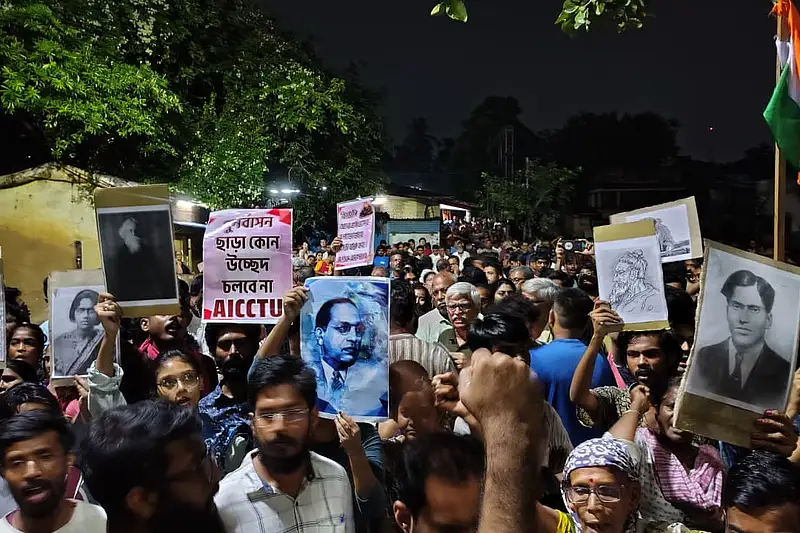
The West Bengal government has launched massive anti-encroachment drives in several railway terminals, asserting drive is aimed at clearing up busy stations to ensure passenger convenience
- PUBLISHED: Mon 8 Jun 2026, 2:49 PM UPDATED: Mon 8 Jun 2026, 4:09 PM


An anti-encroachment drive in Kolkata early Monday morning turned violent as the police clashed with demonstrators protesting against the demolition of scores of shanties, shops and hawkers’ stalls. Two Communist Party (Marxist) leaders were arrested and several protesters suffered injuries and were hospitalised.
“Fascist forces are engaged in bulldozer politics here,” Mohammad Salim, a CPI(M) leader told the media. “Not just state officials, but even railway personnel are also involved. This is the hallmark of BJP-RSS politics. Besides affecting the economy, it is snatching the livelihood of the poorest of the poor.” According to Salim, the officials carried out the demolition despite a stay order.
Recommended For You




The demolition operations began Sunday evening and continued well into early hours of the morning Monday. The police, along with the Rapid Action Force, baton charged many of the activists and students.
Stay up to date with the latest news. Follow KT on WhatsApp Channels.
The Congress, which also joined in the protests, said it had pledged “to stand by the hawkers in future protests wherever the government attempts to snatch away their livelihoods in this manner.” Many party workers were injured due to police action.
Students of Jadavpur University staged a midnight protest. Student leader Debanjan Dey accused the government of unleashing terror on the protesters, who were opposed to the eviction of hawkers. A few days earlier they had stalled the demolitions, but failed to stop it on Sunday-Monday. The students said the drive was being carried out without ensuring adequate rehabilitation for the hawkers and violating court directives.
But the BJP claimed that the illegal encroachments were disrupting normal life in the neighbourhood. Dilip Ghosh, a minister, said the government was looking for alternative space, but thousands of encroaches could not be accommodated.
After the BJP came to power in West Bengal, the government launched massive anti-encroachment drives in many cities and railway terminals. A few days earlier, hundreds of illegal stalls were removed near Howrah and Sealdah stations. The authorities claimed the drive was part of the efforts to clear up the areas around busy stations to ensure convenience for thousands of passengers.
During the state assembly election campaign, Prime Minister Narendra Modi had addressed a gathering in Jadavpur constituency, where he said that the university, Kolkata’s premier education institute, had been converted into hotbed of anarchy. “There are threats inside the campus. They are writing anti-national slogans on the walls and students are forced to hold protests on the roads rather than focusing on their education. We do not want anarchy here, we want an academic environment,” he had said.
Trinamool Congress leader and former chief minister Mamta Bannerjee had said that what Modi had called as ‘anarchy’ was democracy in motion. She described his ‘bulldozer’ policies as anarchy.
