 E-Paper
 Sign In


Could Nefertiti be hidden beyond Tutankhamun's tomb? New scans revive mystery
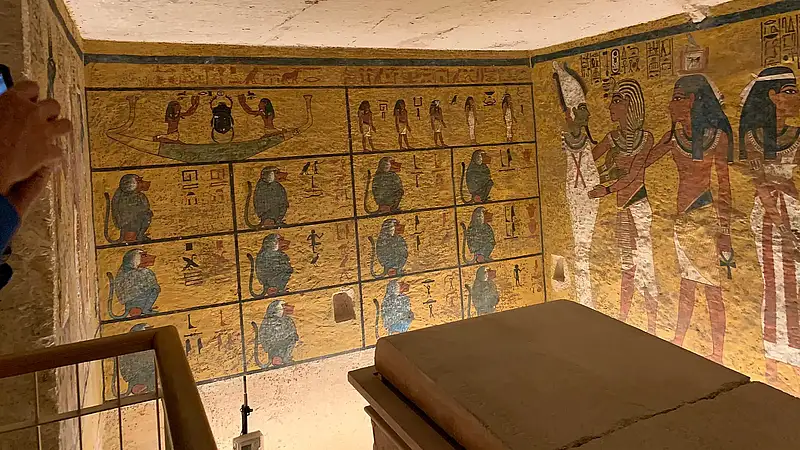
New surveys have detected signs of possible hidden corridors and rooms near the famous pharaoh's burial chamber, reopening a mystery that has divided archaeologists for years
- PUBLISHED: Mon 28 Sept 2026, 6:00 AM


More than a century after Tutankhamun's tomb was discovered in Egypt, archaeologists are once again asking what might still be hidden beyond its walls.
New scans have found signs that could point to previously unknown corridors and rooms near the tomb in Luxor's Valley of the Kings, reviving a long-running theory that the lost burial place of Queen Nefertiti could be nearby.
Recommended For You




But scientists are not claiming they have found her tomb. The latest research used several methods to study the ground around Tutankhamun's tomb, known as KV62, including ground-penetrating radar and microgravity measurements.
Stay up to date with the latest news. Follow KT on WhatsApp Channels.
Researchers say the results suggest there could be a larger complex of corridors and rooms extending beyond the known tomb.
One area was particularly interesting. Researchers detected what appears to be a low-density zone containing a roughly square, higher-density area, which could potentially be a chamber containing objects.
However, the signals are at the limits of what the technology can detect, meaning further investigation is needed before scientists can say what is actually there.
Why Nefertiti?
The idea goes back to 2015, when British Egyptologist Nicholas Reeves suggested that Tutankhamun's burial chamber could be only part of a much larger tomb.
Tutankhamun's tomb has long puzzled archaeologists because it is unusually small for a royal burial.
Reeves suggested that the young pharaoh, who died unexpectedly, may have been buried in rooms originally belonging to an existing royal tomb, with other sections sealed behind walls.
He proposed that those hidden rooms could contain the burial of Nefertiti, one of ancient Egypt's most famous queens.
The theory has been debated ever since. In 2018, another radar survey found no evidence of hidden chambers next to Tutankhamun's tomb, appearing at the time to put the theory to rest.
The latest research has reopened the question by using several different surveying techniques and finding new anomalies around the site.
What happens next?
For now, researchers need permission from Egypt's Supreme Council of Antiquities before they can investigate further.
If approval is given, the team hopes to carefully drill into the area and use small cameras to see what lies beyond. The work could begin as early as November, according to one of the researchers involved in the study.
For now, it remains unclear whether the readings represent ancient rooms or have any connection to Nefertiti. But after years of conflicting scans, the new findings have brought one of Egypt's biggest archaeological mysteries back to life.