 E-Paper
 Sign In


Commentary: US President Trump and China's Xi owe the rest of us a rulebook, not a receipt
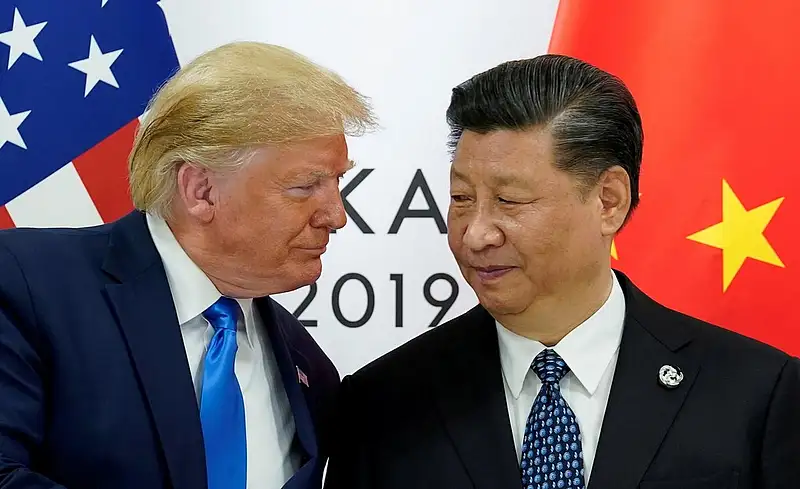
The centrepiece of what Xi and Trump agreed in Beijing in May — a standing US-China Board of Trade — still has no published operating rules four months on
- PUBLISHED: Sun 20 Sept 2026, 12:36 PM
- By:
- Imran Khalid


The author is a geostrategic analyst and senior fellow at Foreign Policy In Focus - USA. His work centres on international affairs and global security.
The Saudi-flagged tanker Sidr was approaching the Strait of Hormuz on August 31 when it was attacked. Sixteen Filipino seafarers were aboard, and two were killed. Philippine Migrant Workers Secretary Hans Leo Cacdac answered by reminding shipowners that a seafarer's right to refuse to sail into a war zone "must be respected."
Recommended For You




Possibly, nobody at the White House state dinner on September 24 —during the meeting between US President Donald Trump and Chinese leader Xi Jinping — will mention the Sidr. The crews who move the cargo, and the economies that live off its movement, nonetheless have more riding on that evening than either host does. So, the only question worth asking is whether the two governments produce anything a third country can plan around.
On present form, no. The centrepiece of what Xi and Trump agreed in Beijing in May — a standing US-China Board of Trade — still has no published operating rules four months on. No convening calendar, no dispute procedure, no product list.
Stay up to date with the latest news. Follow KT on WhatsApp Channels.
US Secretary of State Marco Rubio said after meeting Wang Yi in Manila in July that the board could be ready before the summit. US Trade Representative Jamieson Greer said on September 4 that the likely outcome would be announcements on "operationalising" it.
Operationalising, however, is what governments announce when they have not built anything. It has become conventional in Washington to assume the obstacle is Chinese non-performance. The past nine months do not support it. Beijing closed out the 12 million tonnes of soybeans promised at Busan on January 20, weeks inside the deadline, and has already passed the halfway mark of a 25 million-tonne pledge for this year.
Over the same months, American tariff authority was struck down by the US Supreme Court, replaced by a global surcharge within hours, raised to 15 per cent the next morning, ruled unlawful by a federal court, reissued under Section 301 across 60 economies, and sued over by 25 American states.
Washington also recently postponed an excess-capacity tariff covering South Korea, Japan and 14 other economies. Sixteen governments learned that their tariff treatment is a timing device in somebody else's summit.
None of which makes Beijing a benign counterparty. China's April 2025 licensing regime on seven medium and heavy rare earths remains in force; the truce never touched it. After Beijing added a US supply-chain auditing coalition to a countermeasures list on August 5, Chinese suppliers halted licensed shipments to buyers holding valid paperwork. That is coercion, and it is the strongest card the hawks hold.
The distinction that matters to a trade ministry is procedural rather than moral. Beijing's leverage sits inside a published regime with an application window and a stated scope, which a company can model. Washington's sits in whichever statute has not yet been vacated. A firm can hedge a licence queue. It cannot hedge an appeal.
Is there an alternative?
The Gulf has already seen what the alternative looks like. In July, the US Commerce Department moved the UAE into Country Group A:5, its top export-control tier, ending individual licence requirements for advanced AI chips, and Abu Dhabi can finance a five-gigawatt computing cluster against that because it is a rule with criteria.
China's route to the same silicon is transactional: A 25 per cent surcharge payable to the US Treasury from January, then Beijing admitting about 10,000 chips apiece for ByteDance and Tencent in August. Washington set the price, Beijing set the buyer list, and no rule was written.
Energy is where the missing channel is about to cost everyone. Drones launched from Iraq's Maysan province hit Saudi Arabia's east-west pipeline on September 11, taking out 4 to 5 million barrels a day of capacity built expressly to bypass Hormuz.
The line is out for weeks, and Aramco is shuttling barrels through the strait the pipeline exists to avoid. Brent has traded above $104. China is the most exposed large economy in that arithmetic, running 4.34 million barrels a day of domestic production against 13.91 million barrels of refinery throughput in August, with second-quarter imports down 32 per cent and Iranian supply nearly halved.
The barrels closing that gap are Gulf barrels, on ships whose crews Manila now counts one convoy at a time: 1,834 Filipino seafarers aboard 59 vessels in a single tally of safe crossings.
Beijing now holds a material stake in the security of a waterway it has long declined to pay for, which is the most promising opening either capital has had in years. There is no forum in which to raise it.
The checklist for September 24 is therefore short, and it is not the one being briefed. A convening calendar. A written procedure for lodging a grievance without waiting for the next leaders' meeting. A multi-year rare-earth access text traded against export-control relief. An extension of the truce that lapses on November 10, along with the suspended port fees on Chinese ships. The morning after, on November 11, should settle the question. Either there is a board with rules, or there is a receipt. The Sidr's fourteen survivors will be sailing through the strait either way.