 E-Paper
 Sign In


Commentary: US missile shortages push allies to diversify defence sources
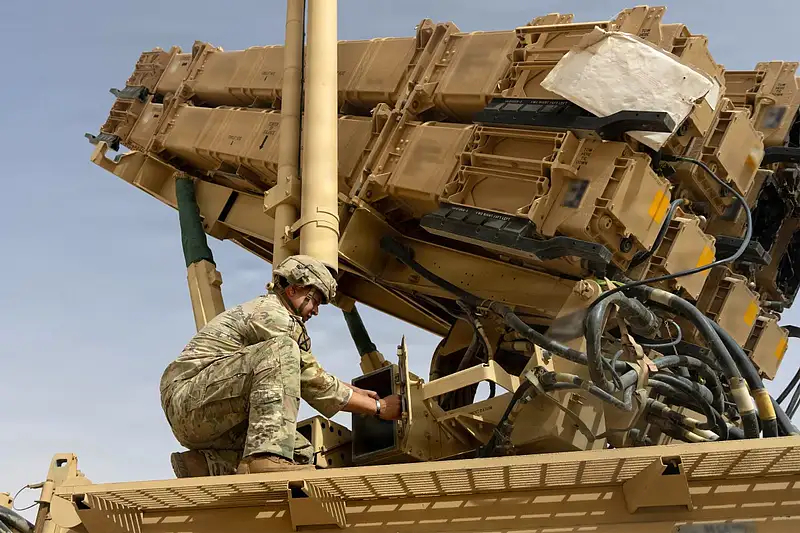
The Center for Strategic and International Studies estimates the US Patriot stockpile fell from 2,330 before the US-Iran war to between 759 and 827 by late July
- PUBLISHED: Thu 15 Oct 2026, 6:00 AM
- By:
- Imran Khalid


The author is a geostrategic analyst and senior fellow at Foreign Policy In Focus - USA. His work centres on international affairs and global security.
Lithuania has offered to pay to be defended. Prime Minister Mindaugas Sinkevičius said on October 6 that Vilnius is ready to cover the costs of a permanent American base, a day after US President Donald Trump said he would “certainly look at it.” The offer followed a summer in which Washington paused a fresh deployment to Lithuania while the Pentagon reviewed its forces in Europe.
Recommended For You




Washington will read this as burden-sharing finally working. It is closer to an ally bidding for a place in a queue. American protection has become scarce, and the scarcest part is not soldiers. It is the missiles that shoot down other missiles.
Stay up to date with the latest news. Follow KT on WhatsApp Channels.
America’s own ledger explains why help was finite. The Center for Strategic and International Studies (CSIS) estimates the US Patriot stockpile fell from 2,330 before the US-Iran war to between 759 and 827 by late July. The conflict has since paused and restarted more than once, and every round draws on the same shelf. Lockheed Martin was building about 600 a year when 2026 began. A contract now worth $58.6 billion is meant to triple capacity, but only by the end of 2030. CSIS has warned that rebuilding these stocks will take at least three years. Allies have to live through the interval.
Europe is entering that interval now. The Pentagon is weighing whether to withdraw 25,000 to 40,000 of the roughly 80,000 American troops on the continent, with options due to Defence Secretary Pete Hegseth by November 6. Congress wrote a floor of 76,000 into this year’s defence bill, but the floor bends if certain conditions are met. Andrius Kubilius, the EU’s defence commissioner, has said Europe buys about 40 per cent of its weapons from the United States, Patriots included, and that American industry needs three to four years to refill its stocks.
Brussels argues about brigades. The decisive number is how many interceptors sit on the shelf. Switzerland can confirm it: Washington has pushed back its Patriot order twice, first the missiles and then the systems themselves, to serve other priorities.
Allies who cannot wait have stopped waiting. When the Strait of Hormuz closed, the UAE did not wait for ships. It sent its own C-17s to Daegu and flew home a third battery six months ahead of schedule.
Europe has found its own exits. Denmark signed for SAMP/T NG in April, turning Patriot down and becoming the first EU buyer of the French-Italian system outside France and Italy. Sweden, Estonia, Latvia, Slovenia and Bulgaria have ordered Germany’s IRIS-T SLM under the European Sky Shield Initiative. Berlin went to Israel for its upper tier. The first Arrow 3 battery deployed outside Israel went live at Holzdorf last December, and the contract has since grown past $6.5 billion, with a second site planned in Bavaria.
The strangest route runs through Japan. Mitsubishi Heavy Industries is building PAC-3 interceptors under licence from Lockheed Martin, about 30 a year by Reuters’ count, and Tokyo has begun shipping finished missiles to US to refill American stocks. When the seller is buying from its own customer, other customers are right to shop elsewhere.
Washington is not counting this cost. American arms sales have always carried political weight beyond the hardware. Spare parts, software updates, maintenance crews and end-use rules keep a US hand on the switch for decades after a sale closes. A Korean battery in the Gulf is one Washington cannot slow, pause or bargain over. Each time the United States rations its interceptors, it nudges another buyer into someone else’s supply chain. That leverage does not return when the Arkansas lines speed up in 2030.
Pakistanis know how this lesson is learned, because they paid for it. Islamabad paid $658 million for 28 F-16s in 1989. In 1990 Washington halted delivery under the Pressler amendment, and settling the dispute took eight years. The army learned the second half of the lesson three decades later. In 2018 it ordered 30 T129 helicopters from Turkey for $1.5 billion, a purchase that looked like a clean break from American suppliers. The helicopters ran on engines that needed an American export licence. Washington never granted it for Pakistan, even after clearing the same aircraft for the Philippines. Islamabad walked away in January 2022 and has since inducted China’s Z-10ME. Changing the seller had not changed who held the switch. Gulf and European buyers now shopping in Seoul, Paris and Berlin will need to read the parts list as closely as the price.
Pakistan’s answer was to move almost wholesale to Beijing. China supplied 81 per cent of Pakistan’s major arms imports between 2020 and 2024, according to the Stockholm International Peace Research Institute, up from 74 per cent in the previous five years. Chinese J-10C fighters and HQ-9 air defences carried the load when fighting with India broke out in May 2025. The JF-17, co-built with China at Kamra, has given Islamabad an industry of its own, and Azerbaijan has signed to buy it. Still, four of every five imported weapons from one country is concentration, not diversification. Pakistan traded one patron for another, knowingly, after Washington had twice shown what its hold on a contract was worth.
Diversification has limits, and the buyers know them. Korea’s defence exports are forecast to top $27 billion this year, up from $15.4 billion in 2025, and factories do not grow as fast as order books. Every Cheongung-II shipped abroad also competes with Seoul’s own missile shield against North Korea. Spreading orders spreads risk without creating new production.
Integration is the other bill. Radars and launchers from different countries do not share data by default, and someone has to do the wiring. The UAE built its state defence group, EDGE, partly to do that work at home. Now it is exporting the model. In June the group launched EDGE Europe, with a Paris head office, a Bordeaux engineering hub, and stakes in Estonia’s Milrem Robotics and Switzerland’s Anavia. Its chairman, Faisal Al Bannai, said Europe “stands at a defining moment for its defence.” A Gulf state that was a customer a decade ago is now selling Europe the industrial depth Europe let wither.
None of this requires Washington to apologise for its priorities. The National Defence Strategy issued in January puts the American homeland and the Western Hemisphere first. It hands Europe “primary responsibility” for its own conventional defence. That is Washington’s right. But a superpower that rations protection by its own calendar should expect its allies to keep calendars too.
A new rotation of up to 1,000 American troops is due in Lithuania this month, and the Pentagon’s options land on November 6. The debate will turn on how many soldiers leave Germany and whether Vilnius’s money buys a base. Washington has a less comfortable question to answer: in the next war, whose factory will its allies call first?