 E-Paper
 Sign In


UAE calls for peaceful settlement of dispute over 3 islands occupied by Iran
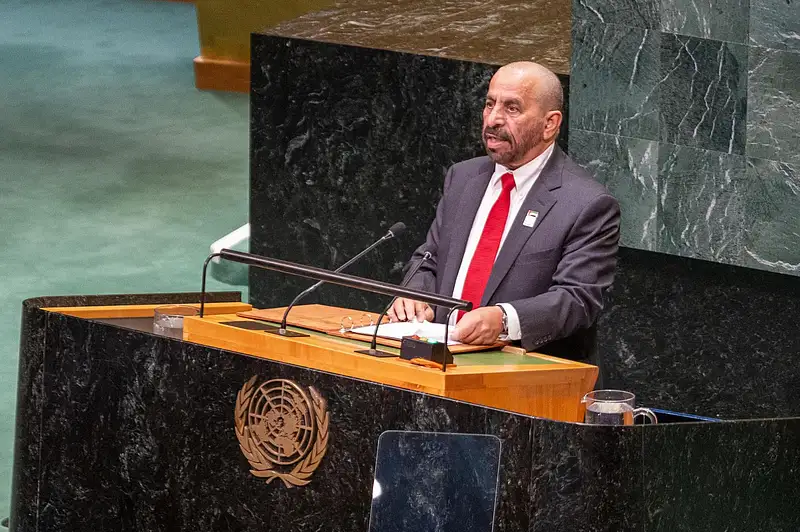
The UAE also reiterated support for a two-state solution to the Palestinian issue, while outlining a foreign policy rooted in de-escalation, diplomacy and dialogue
- PUBLISHED: Tue 29 Sept 2026, 1:39 PM


The UAE has reiterated its rejection of Iran’s occupation of the three Emirati islands of Greater Tunb, Lesser Tunb and Abu Musa. Addressing the high-level general debate of the 81st session of the UN General Assembly, UAE Minister of State Khalifa Shaheen Al Marar called for a “peaceful settlement of this conflict, whether through direct negotiations or by recourse to the International Court of Justice”.
According to the UAE, Iranian military forces occupied the three islands on November 30, 1971, two days before the establishment of the country. The UAE first raised the issue before the United Nations Security Council on December 9 that year.
Recommended For You



Since then, the UAE has repeatedly asserted its sovereignty over the islands, citing historical documents in support of what it says is its legal and historical claim. It has also maintained that it will continue to seek the return of the islands to UAE sovereignty.
Al Marar placed the UAE’s position on the islands within a foreign policy built around de-escalation, bridge-building and the peaceful settlement of disputes.
He said the region and the world were going through a period of rapid transformation marked by growing challenges and divisions, but that the UAE remained focused on turning those challenges into opportunities for peace, development and prosperity.
The minister said this approach was grounded in diplomacy and dialogue, respect for state sovereignty, good-neighbourly relations, international law and the UN Charter, principles he said had long shaped the UAE’s domestic and foreign policies.
Gaza and Palestinian statehood
Al Marar said the UAE continued to back a two-state solution, with an independent and sovereign Palestinian state living side by side with Israel in peace and security.
He said this required a serious political path towards a just and lasting settlement of the Palestinian issue, alongside full implementation of the international plan to end the conflict in Gaza and its associated roadmap.
That plan, he said, should include Israel’s withdrawal from the Gaza Strip, the disarmament of Hamas and the unification of Gaza and the West Bank under a reformed Palestinian Authority capable of assuming its responsibilities, with arms remaining solely under its control.
Al Marar also condemned Israel’s escalation in the West Bank, including settlement activity, settler violence, the siege of Palestinian villages and violations in East Jerusalem and at holy sites.
 For decades, the UAE’s commitment to the Palestinian people has remained unwavering. Today, that commitment continues through our role as the largest provider of humanitarian aid to Gaza, along with our humanitarian and development projects in the West Bank.
Khalifa Shaheen Al Marar, UAE Minister of State
Sudan, Ukraine and regional conflicts
Al Marar said the UAE had continued to support efforts to achieve peace in Yemen, Libya, the Sahel, the Democratic Republic of the Congo, Myanmar and Haiti.
On Ukraine, he reiterated the UAE’s support for a “comprehensive, just, and lasting peace” in line with international law and the UN Charter, including respect for sovereignty, independence and territorial integrity. He said the UAE had carried out 26 mediation efforts that facilitated the exchange of nearly 8,000 prisoners between Russia and Ukraine.
The minister also said the UAE stood ready to support countries undergoing what he described as positive transformations, including Syria and Lebanon, as they move towards greater security and stability.
On Sudan, Al Marar called for a permanent and unconditional ceasefire to end the civil war and the humanitarian crisis. He said this should be followed by a comprehensive political process led by civilians and resulting in a civilian government independent of both parties to the conflict and extremist groups.
“The future of Sudan must be decided solely by the Sudanese people,” he said, calling on the international community to press the Port Sudan authorities and the Rapid Support Forces to engage seriously with international initiatives.
Progress despite regional crises
Al Marar said the UAE had refused to allow the crises surrounding it to undermine the achievements it has built over decades, and had instead continued to make progress across sectors.
“For this nation was forged not in the absence of challenges, but in defiance of them,” he said, adding that people across the region aspired to stability and prosperity built on cooperation, moderation and tolerance.
He said the UAE had strengthened its resilience through investments in industrial capabilities, advanced defence systems, infrastructure and logistics, alongside human capital and a knowledge- and innovation-based economy. He also highlighted the country’s Comprehensive Economic Partnership Agreements with 38 nations as part of efforts to diversify markets and supply chains and expand trade and investment.
Al Marar said the UAE would continue strengthening its role as a global hub connecting markets and capital, while expanding investment in artificial intelligence, emerging technologies, healthcare and education.
Concluding his address, he said the country would remain committed to moderation, rejecting violence and extremism, and investing in people and the region’s potential.
“We extend our hands to our partners in the region and across the world to build rather than to destroy, and to unite rather than to divide,” he said.


As Associate Editor, Sahim Salim helps tell the UAE story like no one else does — and leads a team of reporters that asks the questions to get news and headlines that matter.