 E-Paper
 Sign In





Full marks for playing sports to end obesity in children
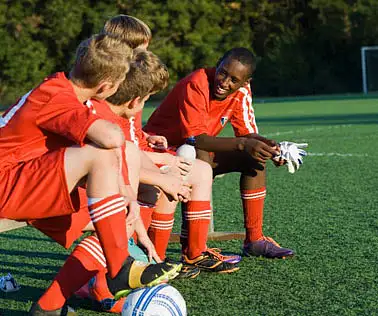
Making sports compulsory will help develop children's soft skills and end the obesity epidemic
- PUBLISHED: Sun 29 Mar 2015, 12:00 AM UPDATED: Tue 13 Aug 2024, 10:39 AM


Adnan Q (full name withheld) is an exceptionally bright 12-year-old boy. His math scores are always way above average and he gets great marks in English, Science, Social Sciences and French. “Adnan's only defeat is in the playground. The boy has never played a sport, he has never run on the tracks, neither has he ever shown interest in a ball,” said Maria Q, his mother.
Adnan was classified as an 'obese' child by his school nurse and family pediatrician. “He is petrified. He worries that if he runs, other children will bully him. He is worried that he won't be able to play as well and has complacently accepted a 'D' grade in Physical Education,” added Maria.
Recommended For You



Maria Q said: “Since Adnan is a shy child, he hardly speaks his mind. That is why I want him to play a sport. So that he develops his soft skills.”
In the UAE, childhood obesity is a matter of concern. According to a study conducted in 2014, over 60 per cent of Emirati nationals are overweight and this figure is expected to rise this year. According to the World Health Organisation (WHO), it is predicted that there will be over 2.3 billion overweight and 700 million obese individuals by the end of this year globally.
In the UAE, medical experts, doctors, child counselors and practitioners in the field of childhood obesity have researched the subject extensively. Different scientific and well-researched methodologies have been applied to alleviate the problem, and Khaleej Times finds out that this epidemic has a very simple solution. Get children to play a sport, and give him or her marks for it.
Marks for sports?
According to sporting experts, teachers, and physical education experts in the UAE, it may be time students viewed sport as part of their curriculum. “They study everything diligently when it is a matter of awarding marks. Why not sports? In the US and India, sport is for the elite. A talented few spend their entire childhood and university playing, but then 75 to 85 per cent drop out after they turn 18. Teaching a child a sport also gives them such valuable life skills,” said Dr George Selleck, advisor to EduSports, psychologist and author.
Dr Selleck is an authority on sports education and sports parenting in the USA, and has coached 25,000 NBA students. He is currently the expert advisor to the Indian company EduSports which has privatised the school sports landscape in India.
EduSports has launched in the Middle East and are operating in two schools in the UAE. Dr Selleck believes that sports, is not a destination but a journey. “Every child needs to try sport. Right from KG1 the child must be involved in some form of play,” said Selleck.
Chipping into the conversation, Meer Waqiruddin Khaleeq, Co-Founder and Head-Business Development of EduSports said: “There are several myths in the minds of parents when it comes to encouraging their children into sports. First and foremost the parents think, 'what if my child is not good at sport'; secondly they think, play time is a waste of time; thirdly they push kids into sports they don't even like to play, because the parents have some kind of unrealised dreams; fourthly they feel that everything a child needs to learn is in the classroom; and finally, sports should not be part of the curriculum. If these myths are busted, more children will enter the sports realm with a positive mindset and will play more actively.”
Parents speak
Father of two young girls Markus Dow said that it is pivotal that children play some kind of sport, but grading is not necessary. “If children are talented, then they need to be nurtured at a higher level. The problem with awarding marks for sports is that it makes things far more competitive and stressful for children,” said Dow.
When parents were asked if they would like to outsource sports education to an expert outside the school, he added: “It could also make things more expensive for the parents and since there are so many facilities across the country, the compulsory physical education with marks awarded for it could pressurise the child,” said Dow. He recommended that families need to be prepared to take children for these extracurricular activities and in the case of Dubai, there are several indoor play facilities.
Schools speak
While some schools are still struggling with the PE curriculum, complaining of lack of participation from students and parents, a few others in Dubai have made participation is school sport compulsory. In schools like Dubai British School physical education is a compulsory subject from Foundation years through to sixth grade. Rhodri Phillips, Director of Sport and Activities at the DBS said: “From an early age Foundation through Primary PE, the pupils are developed in the areas of special awareness, movement, hand-eye co-ordination, sending and receiving skills , individually in pairs/groups and small sided teams into KG2.”
Heather Mann, Principal, Dubai British School – Jumeirah Park said there are some marks awarded based on skill level, participation and effort. She said: “Most parents are aware that being active is good for their child's overall development.”
dhanusha@khaleejtimes.com