 E-Paper
 Sign In


10% Emiratisation target: UAE companies move beyond hiring targets to build careers
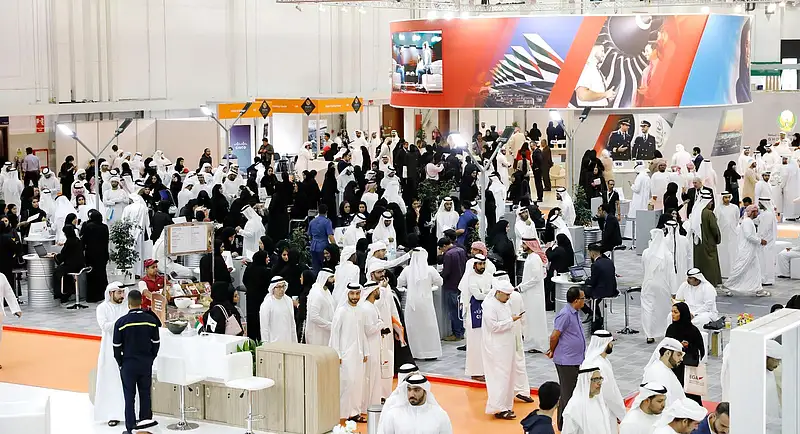
Private companies show how the policy is translating into skilled roles, flexible work and long-term career paths
- PUBLISHED: Tue 29 Sept 2026, 4:33 PM


For a private company with 500 skilled employees, the UAE's end 2026 Emiratisation benchmark translates into 50 Emiratis working in skilled roles.
The rule applies to private-sector establishments with 50 or more employees. Their Emiratisation rate in skilled jobs has been required to rise by two per cent each year, one per cent in each half to reach 10 per cent by the end of 2026.
Recommended For You





Nationally, most covered businesses are on track. The Ministry of Human Resources and Emiratisation said 95 per cent met their first-half 2026 targets. More than 190,000 Emiratis were working across nearly 32,000 private companies by July.
Stay up to date with the latest news. Follow KT on WhatsApp Channels.
Al-Futtaim says Emiratis make up 20 per cent across its UAE businesses. That is numerically above the 10 per cent benchmark, although its published figure is broader and may not use the same denominator specified by Mohre.

The group is focusing on a career pipeline rather than recruitment alone. Around 300 Emiratis participate in its SINYAR platform annually, with 70 per cent enrolled in Explorer, which introduces pupils in Grades 9 to 12 to workplaces, future skills and career options.
Four further stages Graduate, Manager, Leader and Elite take Emiratis from their first professional roles towards management and enterprise leadership.
“Our role is not only to create jobs for Emiratis, but to create an environment where national talent can build meaningful, long-term careers,” said Mira Al Futtaim, Chairwoman of Emiratisation at Al-Futtaim and Chief Future Education Officer at Al-Futtaim Education Foundation.
Abu Dhabi Islamic Bank says its Emiratisation rate has reached 53.7 per cent, its highest level in years. An ADIB representative interviewed by Khaleej Times at Ru’ya said Emiratis were being placed in critical functions rather than being concentrated in back-office jobs. A Dubai Media Office report separately put the bank’s rate at a rounded 53 per cent.
“For us, Emiratisation is not a number only. It is part of our identity at Abu Dhabi Islamic Bank,” Bushra Al Shehhi, Group Chief HR Officer and Chairman of Kawader said.
Women account for 78.3 per cent of ADIB’s Emirati workforce, according to the representative. The bank’s Al Ain Centre of Excellence has more than 200 employees across functions that include compliance, collections and operations. Around 60 to 70 work in collections, while roughly 20 retail employees have been added in Al Ain this year.
This forms part of a plan announced in June 2025 to hire 400 UAE nationals in Al Ain by the end of 2026 across Islamic retail banking, operations, compliance and collections.
Alshaya Group expected to meet its year-end target by the end of the Ru’ya exhibition week.
James Young, head of resourcing operations, said the group had around 50 Emirati employees and was on course to have more than 420 by the end of 2026.
“It was just, ‘We need to get to this number.’ It was less about the people,” Young said of the company’s earlier approach. “Now it’s all about the people and what we’ve seen is that we naturally get to our number without having to worry about it.”
In practice, the change has included flexible contracts that attract more students and a wider spread of head-office roles. Emiratis now work in online merchandising, customer and technology teams and asset protection, with the company seeking greater participation in finance and marketing.
Alshaya also introduced cultural-awareness roadshows for expatriate store managers after identifying high attrition linked partly to assigned tasks and communication styles. Young said attrition fell after the programme.
On October 4, the group plans to launch Grow With Us, a six-month accelerator to prepare Emirati store employees for their next role.


Ruqayya Alqaydi is an associate editor with an endless curiosity to learn. Like a journalist on a caffeine overdrive, she is fuelled by passion and on a mission to uncover every gem in the UAE.