 E-Paper
 Sign In





Workday launches in the UAE as businesses look to get more value from AI
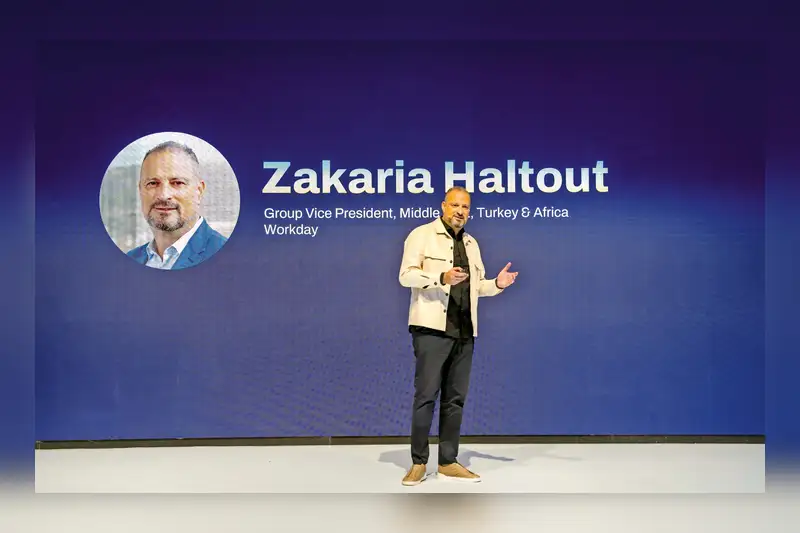
Following Workday’s official launch in the UAE on October 1, Zakaria Haltout, Group Vice-President, Middle East, Turkey and Africa at Workday, explains why organisations need to look beyond AI adoption and focus on where the technology can deliver measurable business value
- PUBLISHED: Wed 7 Oct 2026, 10:42 AM


Amid all the investment and attention around AI, one essential question comes first: what exactly do they want AI to accomplish?
“A common issue is that organisations say they want an AI solution without first defining the use case,” Zakaria Haltout, Group Vice-President, Middle East, Turkey and Africa (META), Workday, told Khaleej Times during a roundtable at the official UAE Workday grand opening. “The starting point should always be a clear question: why do I need AI, and what am I trying to achieve with it?”
Recommended For You





AI is already widely used across UAE workplaces. According to new research from Workday, 90 per cent of employees surveyed use AI at least weekly, 58 per cent who use it several times a week and 18 per cent who use it every working day.
But widespread use does not always translate into straightforward productivity gains. Employees reported saving an average of 3.6 hours a week through AI, while spending 3.4 hours clarifying, correcting or rewriting low-quality AI-generated work.

A more mature cloud market
The launch also highlights how far the region has progressed in its digital transformation journey. Workday was founded as a cloud-native platform with AI built in from the start, but for many years large organisations across the Middle East remained committed to legacy on-premises infrastructure.
The picture began to change as hyperscalers opened data centres in the region, accelerating cloud adoption. Organisations that may once have been reluctant to move critical systems such as HR and finance to the cloud have become increasingly comfortable doing so.
“Today, cloud maturity is significantly higher, which makes this the right time for Workday to enter the market,” Haltout says. The rapid uptake of AI has given Workday another reason to make the move now. The UAE has made AI a major part of its digital and economic ambitions, but Haltout believes attention is increasingly turning towards what businesses can achieve with the technology.
“The UAE is moving from having a vision for AI towards delivering measurable impact,” he says. The Dubai office will give Workday a base to work more closely with customers, develop partnerships and hire locally, while also supporting its wider ambitions in markets including Saudi Arabia. Globally, more than 5,500 customers already leverage one or more of Workday’s AI agents.
Moving AI beyond everyday tasks
For businesses, Haltout says the opportunity goes beyond using AI to write emails, carry out research or help with individual tasks. The bigger shift will come as companies start building the technology into the processes they already use to run their operations.
In finance, for example, AI can be used within processes such as procure-to-pay, working with the organisation’s own data and established rules. “AI in a business environment will not add meaningful value without grounding in the right business context” Haltout says. “It needs to understand the business process, the data and the rules within which it is operating.”
How companies are reinvesting the benefits of AI
Workday’s research also looked at how organisations are reallocating the efficiencies they do gain. Contrary to fears that AI is purely a cost-cutting tool, Workday’s research suggests that businesses are prioritising growth and workforce development over immediate headcount reduction.
According to the study, around 33 per cent of organisations use AI-enabled efficiencies to handle greater workloads without increasing headcount, while 32 per cent said time and cost savings were being directed towards training, upskilling and reskilling employees. In contrast, only 24 per cent focus primarily on traditional cost-cutting measures, such as reducing headcount, vendor spend, or overtime.
For Haltout, these numbers reflect a broader reality, that AI is meant to support employees rather than replace them, making human oversight and continuous skill development essential to successful AI implementation.
As more work is automated, what happens to employees?
For employees, the growing use of AI also brings concerns about what it could mean for their roles.
Haltout says this is where change management becomes important. If businesses are going to automate parts of a job, employees need to know what is changing and what will be expected of them afterwards.
This can be particularly relevant in the Gulf, he says, given the region’s large expatriate workforce and the concern some employees may have that AI could put their jobs at risk.
“If a particular task is going to be automated by an AI agent, employees need to understand what their role will become and how their work will evolve,” he says.
Clear communication must also be paired with a commitment to people through continuous learning and training. Ensuring employees are supported with the right skills to thrive alongside AI builds trust and confidence during these transitions.
Businesses face pressure to keep pace with rapid change
For Haltout, the pace of technological change also means businesses cannot afford to wait too long before adapting.
“Technology is evolving extremely quickly. Organisations that fail to keep pace risk becoming outdated,” he says.
That does not mean adopting AI simply for the sake of it. Organisations still need to be clear about the outcomes they want to achieve and where AI can deliver meaningful value. The focus, he says, should be on moving beyond experimentation and applying the technology within trusted business processes.


As a passionate storyteller and content writer, Kushmita Bose loves weaving narratives that inform, inspire, and entertain. Whether she's unraveling tech revolutions, dissecting industry reports, or bringing a brand’s journey to life, Kushmita thrives on transforming ideas into captivating stories. When she’s not busy crafting content, you’ll probably find her daydreaming about her next travel adventure.