 E-Paper
 Sign In





How Interface is redefining sustainable flooring at Dewa’s Al Shera’a
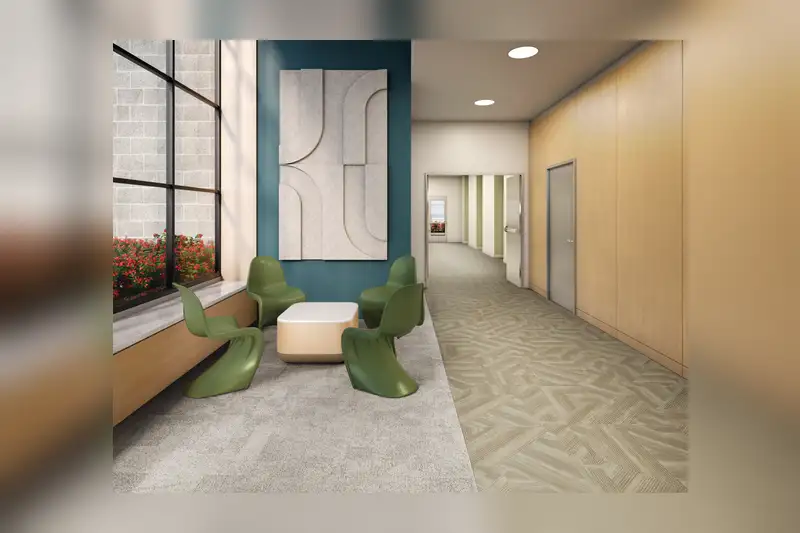
At Dewa’s Al Shera’a headquarters, Interface’s 55,000 square metres of low-carbon carpet flooring tells a business story about material innovation, staying power and turning sustainability specifications into a finished building
- PUBLISHED: Fri 23 Oct 2026, 11:37 AM


When Sheikh Mohammed bin Rashid Al Maktoum, Vice-President and Prime Minister of the UAE and Ruler of Dubai, inaugurated Al Shera’a in Al Jaddaf, Dubai, this year, the headlines went to the height and the artificial intelligence. Dewa’s new headquarters was unveiled as the world’s tallest, largest and smartest net-positive government building. Its Arabic name means ‘sail’, symbolising movement, progress and openness. Few visitors will think about the surface they walk across to admire it.
Interface, the carpet-tile maker, supplied a little over 55,000 square metres of flooring to the project, covering most of the building’s front-of-house areas. Dom Formilleza, the company’s sales and specifications manager, says it was a specification win years in the making.
Recommended For You





The carpet used in the building is from Interface’s Conscient range, built on a bitumen-free, bio-based backing that Becky Gordon, Interface’s EMEA sustainability manager, describes as the product of ‘years and years’ of research. Traditional backings lean on virgin petrochemicals. This one uses recycled and bio-based content instead, and the backing alone is carbon negative because the bio-based material stores carbon. With the yarn included, the finished tile is about 89 per cent recycled and bio-based material.

Gordon puts numbers on it. The range carries a footprint of 6.68 kilogrammes of CO2e per square metre, against an industry average she places at 8 to 10 kilogrammes, ‘and some products much, much higher’. Across the project, that works out to about 369,210 kilogrammes for the entire installation. Using the conservative 10-kilogramme benchmark, the saving comes to roughly 183,500 kilogrammes of carbon, a figure Gordon worked out on the call.
This is Interface’s stated direction. The company has pursued a mission to be carbon negative as an enterprise by 2040, after announcing in November 2019 that it had achieved its earlier Mission Zero goal ahead of schedule. Its own materials say it introduced the first carbon negative carpet tile in 2020, on a cradle-to-gate basis. At Al Shera’a, Gordon says, the approach rests on three questions, namely, how products are made, how long they last, and what happens at the end of their life.
Durability, not just credentials
Formilleza says the brief demanded both sustainability and long-term performance in a government headquarters with heavy daily traffic. The product meets the EN 1307 wear-classification standard for commercial carpet, Interface backs it with a 15-year warranty, and its yarns are cleanable with the correct materials. The 50-by-50-centimetre tile format helps too. For instance, a badly stained tile can be replaced ‘in an instant’, not the whole room.
On indoor air quality, Gordon says the range carries Green Label Plus certification and traps more dust than a typical carpet tile, and far more than hard flooring. Alongside the product’s environmental product declarations, these documents feed into certification schemes such as LEED and WELL. Al Shera’a was designed to achieve LEED Platinum and WELL Gold certification, and Dewa announced in August that the building earned 102 out of 110 points in the LEED New Construction category.
The price question
The obvious objection to sustainable materials is cost. Maliakal answers it directly. Every Interface product is built to the same sustainability standards, he says, so there is ‘no real markup to be more sustainable’. Against European or American manufacturers on a like-for-like basis, he puts Interface ‘5 per cent here, 10 per cent there’, and attributes that to design and manufacturing complexity rather than green credentials. Formilleza adds that even Interface’s lower-priced ranges have low embodied carbon, and that multinational clients increasingly require it. “It’s basically their responsibility,” he says of the carbon they own through the spaces they occupy.
The end-of-life gap
The least settled question is what happens when the carpet comes up. Globally, Interface runs a take-back programme, ReEntry, which takes back used Interface carpet tiles for reuse and recycling. In the Gulf, Gordon says, there is no standard offering yet. Cross-border waste rules exist for good reasons, and this backing can be recycled only at Interface’s European manufacturing site, which makes shipping difficult. The Al Shera’a carpet was made entirely at the company’s plant in Scherpenzeel, in the Netherlands, so that is where it would have to go.
Maliakal says GCC recycling “is not really a viable option as of now,” and that it will take industry-wide action. Interface convened a roundtable with competitors in 2024 to explore reuse, cleaning and charitable routes. Storage, cleaning and logistics all cost money. “It’ll be a slow burn for sure,” he says. “But we do want to get there.”
What comes next
Gordon argues that the low-carbon interior of the next decade will come from circular thinking, which means, transparent product declarations from the start, products that last, and modular formats that let owners replace parts of a floor, not all of it. “Every time you put a new product into a building, that’s more carbon footprint,” she says. Design matters equally. A product with excellent numbers that looks wrong for a space will be ripped out early.
For Maliakal and Formilleza, the proudest moment was not the final tile laid. It was holding the specification against strong competition, on the strength of sustainability credentials, in a project that stretched across nearly a decade. “That’s what drove the spec,” Maliakal says.
Interface has been in the region for more than three decades, and now sells mainly into commercial offices, education, healthcare, hospitality and aviation. If Al Shera’a is any guide, the floor is becoming part of the sustainability story, not just something a building stands on.