 E-Paper
 Sign In


Dh367 million for a bunker? Luxury underground homes are the new trend for ultra-rich
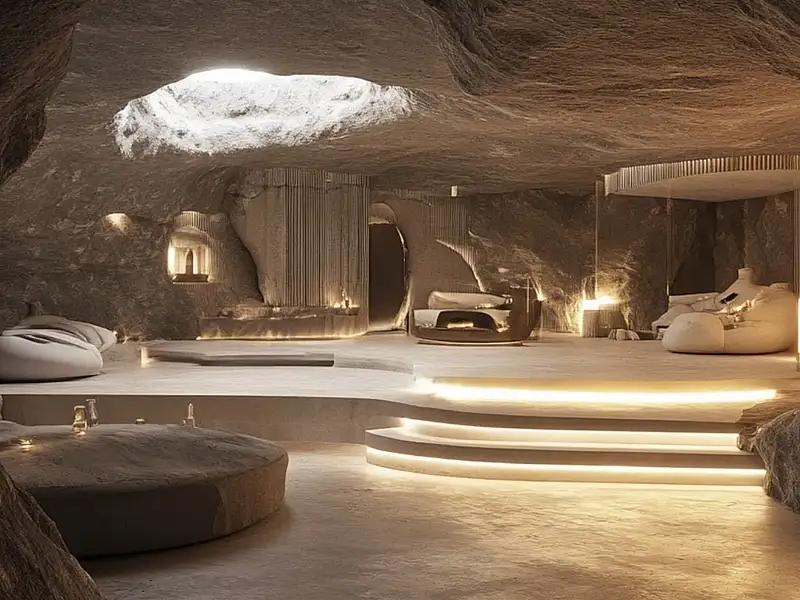
From swimming pools to state-of-the-art gyms and medical centres, these bunkers offer unparalleled security and opulence
- PUBLISHED: Fri 14 Mar 2025, 3:38 PM UPDATED: Mon 2 Jun 2025, 1:10 PM


Forget man caves. Luxury underground bunkers are becoming the must-have for high-net-worth individuals these days, with bowling alleys, medical centres and even secret passageways being built inside them. It’s part planning for a disaster, part creating some extra space to enjoy luxury home living.
When it comes to designing your bunker, your imagination really is the limit. Swimming pools, saunas, staff quarters, state-of-the-art gyms and climate-controlled rooms to store your art collection are becoming the norm, according to developers.

Recommended For You

One of the biggest underground bunker companies is Strategically Armored & Fortified Environments (SAFE), based in Virginia, US. Naomi Corbi, director, Medical Preparedness at SAFE, says: “Trends have always been client-specific, whether it’s fiery moats, Formula 1 racing circuits, or impenetrable museums for world-class collections.”
Stay up to date with the latest news. Follow KT on WhatsApp Channels.
These features don’t come cheap, and a completely outfitted shelter begins at approximately $1 million (Dh3.67 million), although SAFE has completed projects in excess of $100 million (Dh367 million), too. The company is working on an ultra-secure bunker in the US which will have blast-proof doors, unbreakable windows and biometric door-entry systems. There’s even a 30-foot-deep moat with a swing bridge, plus water cannons capable of taking out helicopters and drones. “Bodies of water have and will always play a significant role in security solutions as they provide formidable defences,” adds Corbi.
For the ultra-wealthy, safety and security have always been of paramount importance, and bunkers give them the opportunity to really splash out underground while maintaining their luxury lifestyles. Tech billionaires like Meta CEO Mark Zuckerberg are also fuelling demand with their lavish creations. Zuckerberg is reported to be building a 1,400-acre compound with its own private bunker on the Hawaiian island of Kauai.
Going mainstream
However, underground living experts have observed that bunkers and panic rooms are becoming more mainstream, and less the sole preserve of the ultra wealthy. Steven Humble, president at Creative Home Engineering, said: “In the early days, there were a lot of bunkers that were geared more towards showing off to friends even at the expense of genuine security. But over the last several years I’ve noticed that clients are getting much more focused on actual security and less on kitch. We’ve also seen increased demand from the lower end of the market.”
SAFE’s Corbi agrees, and says while billionaires have always been wise to dangers, her team is getting far more inquiries from millionaires who might traditionally have been content with standard security measures.
Creative Home Engineering specialises in making high security doors for bunkers and panic rooms, and has seen strong demand for camouflaged entry. “Nowadays, it is very easy for criminals to go online and learn the tools and techniques required to breach overt security doors,” he explains.
Both clients and the security firms they’ve contracted now want a security door that is hidden when it is in the closed position. “The majority of our security doors are either pocket doors that disappear when left open, or they’re secret passageway doors that look like bookcases, mirrors, brick walls, when in the closed position,” he adds.
Humble’s company recently built a giant working rotating fireplace that swivels to reveal the underground entrance to a shooting range. Very James Bond.
Health first
Medical care, wellness and longevity have become top priorities among the rich, and this is filtering down into the bunker world. While traditional bunkers were once designed purely for security and survival, today’s high-net-worth individuals are looking for a fully integrated lifestyle experience that ensures their long-term health and well-being needs.
SAFE’s medical suites are designed to rival, and in some cases surpass, the level of care found in top-tier US hospitals. Corbi, a trained nurse herself, compares them to the White House Medical Unit, offering everything from general wellness and preventative medicine to fully equipped intensive care units (ICUs).
Fallout
When it comes to the reasons why people decide to build an underground bunker, there is an element of Doomsday prepping, or more accurately, “having a back-up plan”, according to Dante Vicino, executive director at The Vivos Group, which specialises in renovating military-grade bunkers. His company’s strapline is, “The backup plan for humanity”.
He has seen a trend among families wanting to have their bunker as a second home more than ever before. “I think the desire to have the place set up for long-term residency with creature comforts is growing,” he says. Business has been helped by popular TV shows like Fallout, Paradise and Silo, which all take place in huge underground communities in a post-apocalyptic world. In fact, Vivos is offering a large-scale facility with one base able to hold up to 800 members, similar to Fallout. It’s much cheaper than having your own private bunker and you get to live within a community.
The bunkers that Vicino deals with are inherently secure from all kinds of natural disasters and man-made attacks by design as they are made of very thick concrete, typically with double rebar construction. Vivos’ bunkers are already built by previous entities, like the US Government, so his company turns them into livable spaces, transforming the bunker into a personalised home with bedrooms, kitchens, and living areas.
The community shares amenities like a pool, restaurant, and gym to enhance the quality of life while building a neighbourhood of sorts. This appeals to libertarians who want more control over their day-to-day lives and less government intervention. “You’ll enjoy off-the-grid living powered by solar panels and generators, allowing for comfortable, independent living,” says Vicino.
Vivos is currently building a network of hardened underground shelters strategically located around the world, within reach of the major regions they serve. At full build-out, its goal is to be able to accommodate about one in every million people on Earth.
“Though there’s plenty of talk of luxury, we have always strived to be attainable to as many people as possible through fair pricing and non-discrimination. Not only the rich can afford bunkers,” he says.
Built to last
Shelters built underground automatically make them resilient to surface temperatures. And in order to sustain blast impacts, shelters are normally constructed with thick concrete walls, which further insulates and regulates interior temperatures. These give it natural advantages when it comes to extreme temperatures, for anyone worried about global warming. And with the ability to withstand temperatures in excess of 80 degrees, they could become welcome respites from the brutal Middle East summers.
Underground bunker experts are seeing more demand in this region, and many have built structures for wealthy individuals and governments in this part of the world. While confidentiality is sacred in this sector, one spoke of large-scale survival compounds featuring sustainable energy solutions, food production, and military-grade security it built in Saudi Arabia.
“The demand for secure, high-tech survival solutions in the Middle East is growing rapidly, and we continue to push the boundaries of what’s possible in private security, medical innovation, and long-term sustainability,” adds Corbi. And is there anything that can be built in a bunker? “Sometimes the clients are afraid that their request or security need is really unusual and I assure them that this is all we do every day,” says Humble.
Firey moat, anyone?