 E-Paper
 Sign In


'Bollywood isn't the most welcoming place for women'
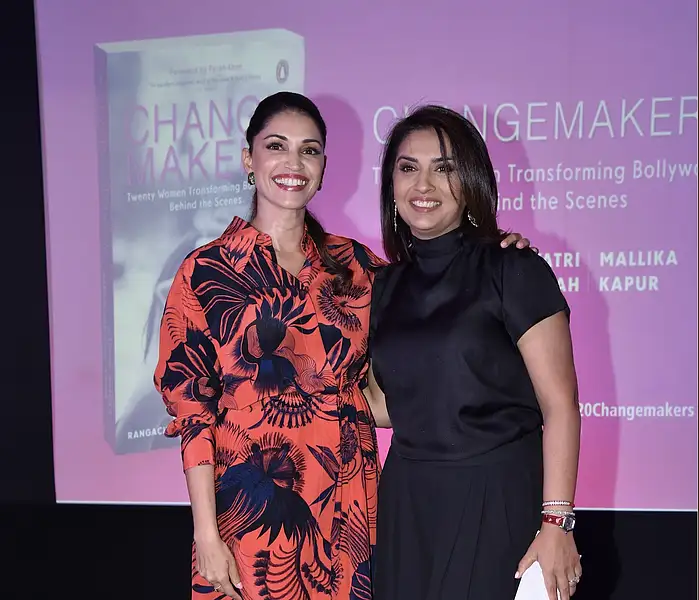
Journalists Gayatri Rangachari Shah and Mallika Kapur have penned a book that throws light on the battles fought by women behind the scenes in Bollywood
- PUBLISHED: Thu 15 Nov 2018, 11:00 PM UPDATED: Fri 16 Nov 2018, 1:00 AM


A makeup artist's six-year-long battle to allow women in the field to work in the film industry. A victim of domestic abuse who went on to become a leading stuntwoman in Hindi cinema. If Bollywood is considered an all-boys club, a reputation cemented by a spate of #MeToo allegations, it is also a place where women negotiate for power and dignity... Journalists Gayatri Rangachari Shah and Mallika Kapur unearth these stories in their new book Changemakers: Twenty Women Transforming Bollywood From Behind The Scenes (published by Penguin). A journalistic perspective on Bollywood means that the 20 stories are not only these women's accounts, they're also peppered with external voices. In an interview, Shah and Kapur tell us why it's important to tell the stories of women behind the scenes.
As 'outsiders' to the world of Bollywood, what led you to look into the role of women in Indian cinema?
Recommended For You





We are outsiders but, like most Indians, feel a cultural affinity to Indian cinema. We have spent a chunk of our careers reporting on gender in some form or another, and, of course, the horrific gangrape of a young medical student in New Delhi in 2012 put the issue front and centre of the national conversation. While reporting on a host of other business, political and social issues on our respective jobs, we both became acutely aware of a startling fact: that less than a third of India's women work. But one industry upending that trend was Bollywood, which has more women working than ever before. This took us by surprise, because the Hindi film world has always been known as an all-boys club. We were intrigued. Who are these women? What's changed in Bollywood? How are they changing our films - and what does this tell us about India? We started doing our research and came across incredible women who work behind the scenes of Hindi cinema.
There is an interesting mix of women in the book - some coming from positions of privilege while others are constantly negotiating for respect. What is the difference in the nature of battles they face in Bollywood?
That's an interesting observation. Even though some of the women come from more privileged backgrounds, what we found is that nobody had an easy entry into Bollywood. It isn't the most welcoming place for women. No matter what a woman's background is, she still has to fight to be taken seriously.
The book comes out at a time when #MeToo exposes certain power structures in Bollywood. The film industry that one reads about through the eyes of your protagonists is not quite an irredeemable world. If there's discrimination, there's also a possibility to rise above that. Is that an interesting contradiction about Bollywood?
We don't think these inherent contradictions are unique to Bollywood per se. They exist in all industries around the world because patriarchy exists everywhere. The reality is that women are not equal in the workforce anywhere. Pay differentials are one manifestation of that and even advanced Western societies are plagued by this. Don't forget, #MeToo began in Hollywood, in a country which is meant to have much more equal relations between men and women. In fact, that is not the case as we have found out over the past 18 months. What's truly amazing is that women are able to rise despite the discrimination.
How supportive are women of each other in the industry?
Most of the women will say yes, that other women support them. Farah Khan (choreographer and filmmaker), who wrote the foreword, has championed many of the women we feature. She gave Rohini Iyer, the reputation manager, a chance to manage the publicity for her first big budget commercial entertainer. She has mentored choreographer Geeta Kapur throughout her dance career. During the years women were not allowed to work as makeup artists on a film set (a trade union rule that went unchallenged for six decades), Farah hired a woman to do makeup for her stars. So yes, we've seen many cases of women supporting women, but let us not forget that equality is not a woman's issue, it's everyone's issue.
At a time when much of Bollywood news is either PR-approved stories about stars or gossip, the room for conversation on those at the periphery is often small. How important is it to view Bollywood through a journalistic lens?
It's extremely important, especially since this is an industry that sets the tone for popular culture in India. The movies we watch influence the way we think and have the power to move the needle on social issues. Movies like Vicky Donor, written by Juhi Chaturvedi, whom we profiled, lifted the stigma associated with IVF and sperm donation, at a time when fertility issues were problematic for couples across the country. Anupama Chopra, the critic whose story we share, is a pioneer in this regard as a film journalist. She is the one who broke the story on the underworld financing Bollywood films in the 1990s. Anupama has doggedly reported on the ins and outs of the movies and her work has helped put our movies into a cultural and social context. Bollywood is part of India's soft diplomacy and it was important to examine it.
What does the constantly evolving role of women in Hindi films indicate for India, at large?
It indicates the dawn of a new kind of cinema, one that has different perspectives and realities. Whether it's English Vinglish, The Lunchbox or Piku, these films are atypical and who knows if they would have been made a decade ago? We hope this type of evolving content helps to change mindsets in a country that is so rapidly transforming.
anamika@khaleejtimes.com


Anamika Chatterjee is Associate Editor, Features at Khaleej Times. A senior journalist, she helms arts, culture, entertainment and lifestyle verticals for the print and digital platforms of the publication.