 E-Paper
 Sign In


EAC fund chief strategy officer Howard Chang delivers keynote address at Money20/20 Middle East
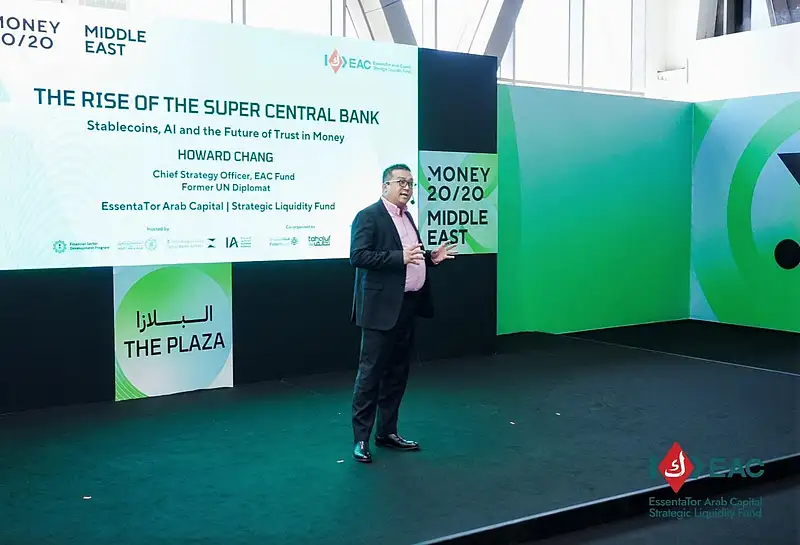
The keynote explored how central banks can approach AI, stablecoins and digital finance while maintaining monetary stability and regulatory oversight
- PUBLISHED: Thu 17 Sept 2026, 4:56 PM


Howard Chang, Chief Strategy Officer of EssentaTor Inc., former UN diplomat and independent investor, delivered a keynote address on behalf of the EssentaTor Arab Capital Strategic Liquidity Fund (EAC Fund) at Money20/20 Middle East. He examined how regulation, stablecoin policy and AI-enabled infrastructure could influence monetary resilience and national competitiveness.
Chang urged central banks to combine prudent oversight with rules that can adapt to digital finance. Regulation must protect stability and market integrity, he said, but outdated frameworks may restrict responsible innovation and access to emerging infrastructure. "First-rate regulation creates room for responsible markets. Second-rate regulation follows markets. Third-rate regulation closes markets," he said.
Recommended For You





Referring to developments in the United States, Chang highlighted the GENIUS Act’s federal framework for payment stablecoins, the Digital Asset Market Clarity Act under consideration and proposed Office of the Comptroller of the Currency rules for implementing the GENIUS Act. He presented these measures as examples of regulatory clarity supporting innovation while preserving oversight.

Chang described one-to-one reserve backing as a liquidity and redemption framework, not a requirement for reserve assets to remain static. He said USD stablecoins could extend dollar liquidity through continuous cross-border settlement networks. However, issuing a local-currency stablecoin would not automatically generate international demand; adoption also depends on currency liquidity, market depth, settlement connectivity and practical use cases. He defined monetary sovereignty as engaging globally while preserving domestic stability, policy control and the local currency’s role.
His address proposed three frameworks. First, an integrated dual-track model would preserve local currencies as the foundation of domestic activity while providing regulated access to fully reserved USD stablecoins for cross-border liquidity and settlement. Coordinated oversight could help manage currency flows, reserve allocation and foreign-exchange risk.
Second, Chang outlined an AI-powered account framework for banks and payment institutions, combining AI-enabled customer service, real-time settlement, stablecoin compatibility and greater operational efficiency. The EAC Fund aims to help central banks create innovation frameworks that enable domestic institutions to modernise legacy systems.
Third, he called for interoperable accounting standards covering the recognition, valuation, settlement, risk management and disclosure of stablecoins and other digital assets. Greater consistency, he said, would help companies incorporate digital assets into formal reporting and could strengthen credible jurisdictions as regional financial centres.
Through the EAC Fund, EssentaTor plans to work with central banks and financial institutions on institutional credibility, financial infrastructure and responsible digital-finance adoption. "Stablecoins are tools to govern, and AI is leverage to manage," Chang said. "True stability is not immobility. True sovereignty requires continued evolution."