 E-Paper
 Sign In


$7 trillion in South–South trade puts fastest-growing economies at centre of global trade
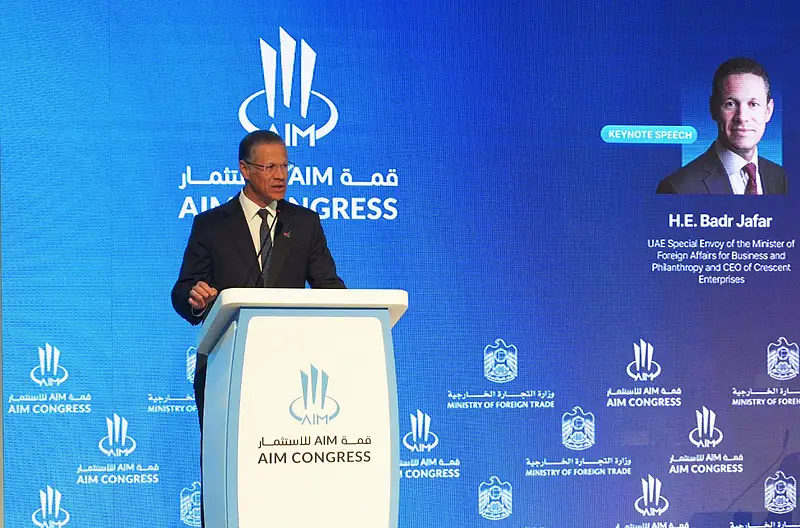
AIM Congress keynote says the routes and partnerships that were held during this year’s disruption to Gulf shipping were built years earlier, and the next ones must be built before they are needed
- PUBLISHED: Tue 8 Sept 2026, 9:27 PM


The world’s fastest-growing economies are not the periphery of the next global trading system but the place where it is being built, AIM Congress 2026 heard on Tuesday, with South–South trade now worth nearly $7 trillion a year, roughly a quarter of all goods traded globally, and the architecture of trade increasingly built government to government and then business to business.
The message came in the keynote of the Congress’s Global Markets Pillar at Dubai World Trade Centre, delivered by Badr Jafar, Special Envoy of the UAE Minister of Foreign Affairs for Business and Philanthropy, who said the world’s trading system had been put to the test this year, and that the key parts of those were built long before they were needed. Pointing to the way ports on the UAE’s east coast, and overland corridors, absorbed rerouted cargo within weeks.
Recommended For You

Jafar stated, “None of that capacity was improvised. It was built years earlier, through corridors that already existed, partnerships that already existed, and trust that already existed. That is the first lesson of this year. The question is no longer: how efficient is Plan A? The question is: how credible is Plan B?”
“The UAE has signed nearly 40 economic partnership agreements in record time, and half are already in force. Governments agree with the principles. Business puts them into practice. Government to government, then business to business, node to node,” he added.
Commenting on the importance of trust in an increasingly digitized system, Jafar stated, “AI can now reroute a supply chain before a human has finished reading the alert. But the more intelligent trade becomes, the more it depends on something ancient: trust. Data has to be trusted. Standards have to connect. And when the system breaks, people have to pick up the phone,” he said.”
He went on to identify philanthropic capital as a third, under-recognized builder of trade architecture, saying “There is a third builder: philanthropic capital. It is patient. It is catalytic. And it asks a different question. Not ‘what is the return?’ but ‘what is missing?’ What is missing, in so many places, is the connective tissue. Philanthropy is beginning to fund that tissue, quietly and deliberately. Government holds the frame. Business lays the cables. Philanthropy strengthens the nodes. That is a whole-of-society architecture that the UAE believes passionately in. And it is the kind that holds.”
Jafar said the UAE had strived to keep its doors open through oil shocks, a financial crisis, a pandemic and this year’s turbulence, and to build more than one gateway, on the Gulf and on the ocean beyond it, with non-oil foreign trade up 13 per cent in the first half of 2026. He commented, “That was not luck. It was built long before it was needed. And none of this was built for the UAE alone. A gateway is built for others to pass through it.”
The keynote opened the Global Markets Pillar’s leaders’ session on trade competitiveness, with government and private-sector leaders from Cambodia, South Africa and Uganda.
