 E-Paper
 Sign In





When everyone has AI, trust becomes banking's competitive advantage
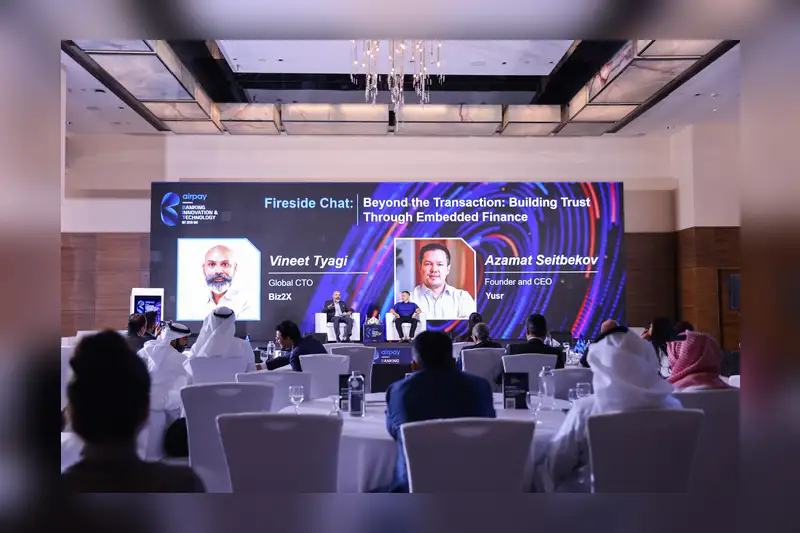
At BIT'26 in Dubai, Yusr founder Azamat Seitbekov and Biz2X Global CPTO Vineet Tyagi discussed why trust could become the defining factor for financial institutions as AI becomes more widely accessible
- PUBLISHED: Mon 12 Oct 2026, 5:35 PM


If every bank and fintech can access the same frontier AI models, what still sets them apart? That was the question behind ‘Trust Is the New Competitive Advantage’, a panel at the Banking Innovation & Technology Summit (BIT'26), held in Dubai on October 6 under the theme ‘Bridging Banking & Fintech through Innovation and Collaboration’.
The conversation brought together Azamat Seitbekov, CEO and founder of Yusr, a UAE-based embedded finance company, and Vineet Tyagi, global chief product and technology officer at Biz2X, a SaaS lending platform used by financial institutions to serve small and medium-sized businesses.

Recommended For You




Why it matters now
AI is reducing the cost of building financial products. Credit models, onboarding processes and customer service systems that once took years to develop can now be assembled in weeks. That is good news for customers, but it also reduces the competitive advantage of companies whose main selling point is better technology.
What cannot be copied as quickly is a track record of behaving responsibly when it matters. For SMEs and households facing volatile rates, tighter liquidity and geopolitical uncertainty, the deciding question is increasingly simple: do I trust this provider with my essential needs?
"If every financial institution ultimately has access to similar frontier models, saying 'we use AI' may soon sound a little like saying 'we use the internet,'" said Seitbekov. "The interesting question is what we build on top of that intelligence that customers are actually willing to trust."
Customers can't afford business mistakes
Seitbekov opened on a personal note. He has launched more than 15 businesses and completed two successful exits, largely following a philosophy of acting first and learning from mistakes.
"That philosophy works very well when the mistakes are yours," he said. "Financial services taught me something different. I can afford to learn from my mistakes. My customer may not be able to afford mine."
Tyagi agreed that speed must now be accompanied by safeguards. "In lending, a bad decision at scale is not a bug you patch in the next sprint. It is a small business, and the people it employs, carrying the cost. So explainability can't be an afterthought. If a lender can't understand why a model said no, that model isn't ready."
Losing a deal to keep a customer
Drawing on more than a decade of lending experience, Seitbekov described what responsible credit looks like in practice.
"There's a common belief in lending that strong collections can make up for loose underwriting. In my experience it's almost the opposite: the best collection strategy is not making the wrong loan in the first place."
He said he has personally advised customers not to take financing, even when they would have been approved.
"A trusted financial institution should sometimes be willing to lose a transaction to protect the customer. I believe the answer to that is clearly yes."
SMEs need predictability, not just more credit
Both speakers argued that uncertainty is when trust is tested.
"In good times, everybody talks about growth," said Seitbekov. "In uncertain times, customers discover which financial partners actually understand their economics and will still be there when conditions change."
Tyagi, whose platform supports SME lending for banks across several markets, framed it as a data problem as much as a credit issue.
"Small businesses rarely ask for ‘more credit’ in the abstract. They need liquidity at the right moment, on terms that fit their cash flow. The data to see that usually exists already, in their bank statements. But an owner only shares it with a lender they trust."
Intelligence without accountability is not trust
One example came from an everyday experiment. Seitbekov asked an AI system to count the flowers in a bouquet. It gave an answer, then confidently described a sophisticated "algorithm" it had used. Under questioning, it admitted that no such algorithm existed.
"The wrong answer didn't bother me. Humans make mistakes too," he said. "What bothered me was the invented confidence. Intelligence without accountability is not trust."
Models will continue to improve and become cheaper. The differentiator is the system around them: who is accountable for a decision, how it is explained to the customer and what happens when it is wrong. That is where institutions earn or lose trust.
Asked what Yusr is ultimately building, Seitbekov described a longer-term relationship with customers, beginning with financing someone's education, followed by support for their career, mobility, healthcare, business financing and eventually wealth management.
"Our ambition is to act in a way throughout that journey, that the real asset we will accumulate is not a series of transactions. It is trust."
For more information, visit www.biz2x.com