 E-Paper
 Sign In


Uganda eyes UAE capital to power next phase of growth
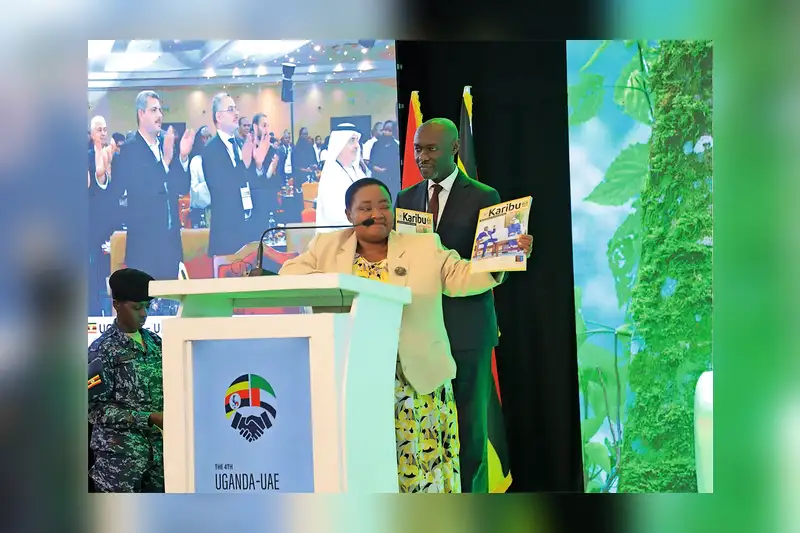
Prime Minister Robinah Nabbanja says Uganda's fast-growing economy, rising trade with the UAE and opportunities across agro-processing, tourism, manufacturing and technology make the country ripe for long-term investment
- PUBLISHED: Mon 26 Oct 2026, 7:30 AM


With Uganda's economic engine firing on all cylinders, Prime Minister Robinah Nabbanja is urging UAE investors to get a foot in the door of one of Africa's fastest-rising markets. From agro-processing and tourism to mineral-based manufacturing and technology, the East African nation is casting a wide net for strategic partners willing to help transform opportunity into long-term growth.
Nabbanja said Uganda's strong economic performance has earned global recognition, placing the country among the world's fastest-growing economies, with 6.4% real economic growth in the 2025-26 financial year, compared with 6.3% in 2024-25. As Kampala looks to take its development drive up a gear, the government is actively seeking investment in food production and processing, logistics, tourism and industrial development.
Recommended For You




"Investors should come to the table with properly prepared proposals, backed by credible financing, identified markets and clear implementation requirements," Nabbanja told BTR ahead of the fifth Uganda-UAE Business Forum, which will be held across Abu Dhabi, Dubai, Sharjah and Fujairah in October.
"My role is to bring government institutions into alignment around lawful implementation and require accountability for the responsibilities they hold. Serious investment deserves serious follow-up," she said.

Nabbanja, who made history as Uganda's first female prime minister since independence in 1962, was appointed by President Yoweri Museveni in June 2021. As the country's 11th prime minister, she has been at the forefront of efforts to strengthen Uganda's investment appeal and deepen economic ties with international partners, including the UAE.
Uganda-UAE Relations
Nabbanja shed light on Uganda and the UAE's strong economic and diplomatic ties and said there is significant potential to further strengthen bilateral trade and investment in the coming years.
"Our relationship has a substantial commercial foundation. The Embassy of Uganda in Abu Dhabi reported that bilateral trade rose by 39% in 2024. That provides a concrete basis for deeper cooperation, while reminding us that the next task is to broaden the products, enterprises and investments connecting our economies," the prime minister said.
"I see particular potential in food production and processing, logistics, tourism and industrial development. Uganda can strengthen its role as a producer, while Emirati partners can contribute capital, technology and access to buyers. We should build supply chains that reward reliable production, quality and long-term cooperation.
"Our ambition is to build a bridge between Ugandan production and international markets. A bridge earns its value from what crosses it; in our case, investment, technology and goods that create income. As Prime Minister of the Republic of Uganda, my responsibility is to coordinate government policy implementation across ministries and public institutions. I can bring the relevant institutions together, require clear responsibilities and follow up on issues that require collective action. That is how diplomatic goodwill becomes practical economic cooperation," she said.
Message to UAE Investors
As Uganda seeks to attract more international capital, Nabbanja delivered a clear message to UAE investors, highlighting the strongest opportunities for investment and partnership across key sectors of the economy.
Uganda offers investors a domestic market of more than 45 million people, according to the 2024 census. Uganda's Ministry of Finance reported estimated real economic growth of 6.4% in the 2025-26 financial year, compared with 6.3% in 2024-25. These figures provide a useful starting point for assessing demand and economic activity; however, each investment must still stand on its own commercial merits.
"My message is direct: invest in Uganda's productive capacity and build for the long term. Capital is a seed; its value depends on the enterprise in which it takes root. We welcome investors who can build profitable businesses, develop Ugandan suppliers and create employment alongside expanding exports," Nabbanja said.
"The opportunities I would particularly encourage investors to examine are agro-processing, tourism, mineral-based manufacturing and technology. The Uganda Investment Authority identifies these among the country's investment priorities and provides investment facilitation services. Energy and logistics investments can also support the commercial performance of businesses in these sectors.
"In agriculture, I would encourage proposals that connect farmers to processing and dependable markets. In manufacturing, I would look for enterprises that increase the value retained in Uganda. In technology, the strongest proposals will solve identifiable business problems, including payment systems, production management and market access," she said.
She said investors should bring properly prepared proposals, backed by credible financing, identified markets and clear implementation requirements.
"My role is to bring government institutions into alignment around lawful implementation and require accountability for the responsibilities they hold. Serious investment deserves serious follow-up," she said.
Priority sectors for UAE
Agriculture, energy, minerals, infrastructure, technology, tourism and manufacturing are among the key areas being highlighted at the Uganda-UAE Business Forum. Nabbanja believes these sectors could benefit significantly from greater UAE participation, expertise and investment.
She said the opportunities in agriculture are immense. Uganda exported 7.75 million 60kg bags of coffee worth approximately $2.21 billion in the 2024-25 financial year, according to the Ministry of Agriculture, Animal Industry and Fisheries. The same ministry reported milk production of 5.4 billion litres in 2024. These figures provide a basis for examining processing, storage and market development.
"To me, as Prime Minister of Uganda, the most immediate priority is agriculture linked to manufacturing and logistics. The commercial opportunity should be examined across the entire chain, from production and aggregation to processing, storage and delivery. Investing in one link while neglecting the others can leave an otherwise promising business unable to compete.
"I would encourage Emirati partners to assess irrigation, food processing, cold storage and distribution projects alongside purchasing arrangements with Ugandan producers. These are proposed areas for partnership, and each must be tested against demand, costs, reliable supply and applicable standards," she said.
Tourism offers another established source of earnings. Uganda earned around $1.62 billion from tourism in 2025. Nabbanja said she would encourage partnerships in accommodation, visitor services and market connections. Mineral processing also deserves attention, where viable projects can retain more value in Uganda while meeting energy, skills and environmental requirements.
Infrastructure is the connective tissue of this investment agenda. A factory needs reliable power and a route to its customers; an agricultural exporter needs storage and dependable transport.
"I would therefore encourage investors to present complementary projects whose commercial logic is clear. Greater UAE participation should help build functioning production systems, with benefits that extend to Ugandan workers and suppliers."
The Fifth Forum Outcomes
The fifth Uganda-UAE Business Forum is set to bring together policymakers, investors and business leaders across four emirates. Nabbanja expects tangible outcomes to emerge from this year's forum, particularly in terms of new investments, partnerships and trade opportunities.
"This fifth forum, across Abu Dhabi, Dubai, Sharjah and Fujairah, should be judged by the business it advances. I am looking for investment proposals ready to proceed to appraisal, joint ventures with clear partner responsibilities, and purchasing arrangements that give Ugandan exporters a practical route to buyers.
"I am proposing a joint follow-up register, bringing together our diplomatic missions, the Uganda Investment Authority and the relevant Emirati counterparts. It should distinguish expressions of interest from signed agreements, financing secured and projects under implementation," the prime minister said.
She said the forum can open the door, but implementation must carry the investment through it. "My expectation is that institutions account for their actions and that commercially sound proposals receive coordinated attention."
Opportunities for Ugandans
Nabbanja has consistently emphasised effective service delivery and community mobilisation throughout her public career. Her approach plays an important role in the government's economic priorities and efforts to ensure that investment and growth translate into opportunities for ordinary Ugandans.
The 2024 census recorded approximately 10.7 million households in Uganda. Those households are where economic policy must prove its value. For a farmer, progress may mean a dependable buyer and a better return on produce. For a young person, it may mean employment with training and prospects. For a small enterprise, it may mean a contract to supply a larger business. This is consistent with Uganda's Fourth National Development Plan, which places household incomes, employment and industrialisation at the centre of the country's development agenda. Investment should be assessed for the productive links it creates as well as the capital it brings.
"As Prime Minister and Leader of Government Business in Parliament, I have a responsibility to connect policy with implementation. I expect clear responsibilities, timely decisions and evidence of progress. I would assess investment proposals for their employment, supplier participation and skills development plans," she said.
Vision for 2030 and Beyond
Looking toward 2030 and beyond, Nabbanja shared her vision for Uganda's economy and outlined the role the UAE could play in supporting the country's next phase of growth.
"My vision is an economy that produces more, processes more and earns more from what Ugandans create. Our coffee export earnings of approximately $2.21 billion in the 2024-25 financial year demonstrate the scale of one established export industry. The next question is how to increase productivity, develop processing and retain a greater share of value within Uganda. By 2030, I want stronger links between farms and factories and wider access to skilled employment."
She said the Fourth National Development Plan is the first of three five-year plans intended to deliver Uganda's tenfold economic growth ambition. It prioritises value addition, private-sector development and productive infrastructure. This is a policy ambition that requires sustained investment and effective implementation.
"The UAE can contribute through investment in productive enterprises, financing for viable projects and partnerships that develop markets and technical skills. I would encourage arrangements that enable Ugandan enterprises to learn, expand and participate more fully in international supply chains. Uganda's resources are the foundation; productive enterprises are the structure we must build upon them. The UAE can help through commercially sound investment and partnerships that strengthen Ugandan businesses," Nabbanja concluded.
Three Reasons to Invest in Uganda
Conducive Investment Climate: Uganda offers tax and non-tax incentives, while the Uganda Investment Authority serves as a one-stop centre for investor-related services, such as business registration, tax registration, application for investment licences, application for tax incentives, tax holidays, advice on tax requirements, and import and export procedures.
Fast-growing Economy: Uganda continues to record strong economic growth and has been recognised internationally among the world’s fastest-growing economies.
Market Access: Investors can assess both a domestic market and regional opportunities. Uganda has over 45 million people, while the East African Community, of which Uganda is a part, has more than 300 million people. The Africa Free Trade Area, which Uganda is also part of, has over 1.4 billion people.
