 E-Paper
 Sign In





UAE student explores how recycled concrete could reduce mountain quarrying
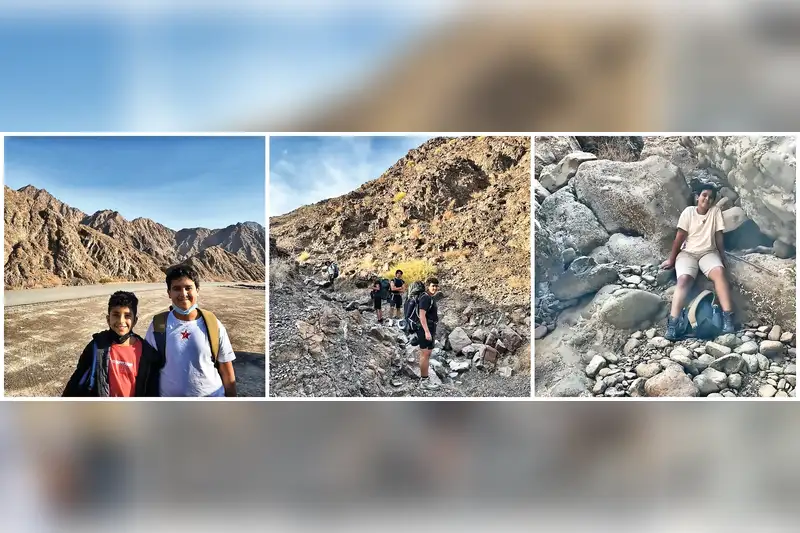
Research into recycled construction materials shows promising results for concrete strength, offering a potential alternative to newly quarried aggregates
- PUBLISHED: Mon 26 Oct 2026, 10:30 AM


Can we build without destroying our mountains? It is a question we simply must answer as construction increases across the region.
Having hiked the Al Hajar Mountains himself, Nord Anglia Dubai student Sultan Al-Farhan has seen first-hand what makes this landscape so special and, by extension, sacred. He has also become increasingly concerned about the impact continued quarrying could have on the mountains and the environment.
Recommended For You


It would be easy to simply highlight the problem, but rather than doing this, Sultan went a step further when he decided to investigate whether there might be a more sustainable alternative.
Alongside the esteemed Dr Zaid Ghouleh from Carboclave and his work with Ducon Industries, Sultan’s research explored whether recycled aggregates from demolished buildings and their concrete could be repurposed to produce concrete blocks as strong as those made with virgin aggregates. This has long been debated in the construction industry, with resistance to recycled materials contributing to a negative environmental impact owing to a lack of recycling and excessive quarrying. After completing extensive lab testing, Sultan’s findings suggested that recycled aggregate concrete blocks can indeed be just as strong as those made using newly quarried materials.
Sultan's lab research produced some extremely encouraging results. In layman’s terms, after just seven days, concrete made with recycled aggregates and treated with carbon dioxide reached a compressive strength of 38.70 MPa, compared with 33.87 MPa for the untreated control, an improvement of 14.3%.
The treatment they carried out also captured CO² within the concrete. The longer treatment absorbed CO² equivalent to 3.02% of the cement's mass, compared with 1.63% in the shorter treatment, almost doubling the amount captured. Although this preliminary study requires further testing and larger scope to validate the findings, the initial results provide the foundation that recycled construction materials could offer a promising alternative to relying entirely on newly quarried aggregates.

To provide some context to the issue, the Al Hajar Mountains span approximately 700km across the eastern Arabian Peninsula and boast a remarkable and breathtaking geological landscape. Their distinctive rock formations are popular among hikers as well as being of scientific interest, so quarrying raises significant and valid concerns about landscape damage, dust and pollution.
Quarrying can cause dust, noise and pollution. Both construction and demolition waste present another challenge: tonnes of valuable materials are often discarded rather than reused, accumulating daily as construction and demolition waste.
What makes Sultan's research unique within the industry and the region is that it poses a simple but imperative question: if it is the case that we can reuse materials from demolished buildings without compromising strength, do we need to rely so heavily on extracting new materials from our mountains? And if we can repurpose materials in such a viable manner, then we should consider these environmentally friendly options. This aligns with Dubai Municipality’s goal to be completely landfill-free by 2027 and divert waste for reuse.
“Recycled aggregates may not replace virgin materials in every application, and, of course, further testing is needed to establish their suitability for different uses. However, our findings offer an encouraging starting point for exploring more sustainable construction practices,” Sultan says.
This could, in turn, set a standard for more recycling across the construction industry, for example, by repurposing steel, glass, wood and other valuable materials from demolished buildings. There is also the case that this process can be used in construction, as a recent article on Sultan’s carbon-neutral ping-pong table attests.
Without question, this is a brilliant example of a student taking something he cares about, asking pertinent questions and building on the expertise and scientific research of carbonation expert Dr Zaid Ghouleh, a pioneer in the field, to explore a practical solution. Protecting our natural environment is not just about recognising what we stand to lose; it is about finding better ways to move forward and sustain our planet.