 E-Paper
 Sign In





Schneider Electric and ASUS map the future of AI factories at Dubai round table
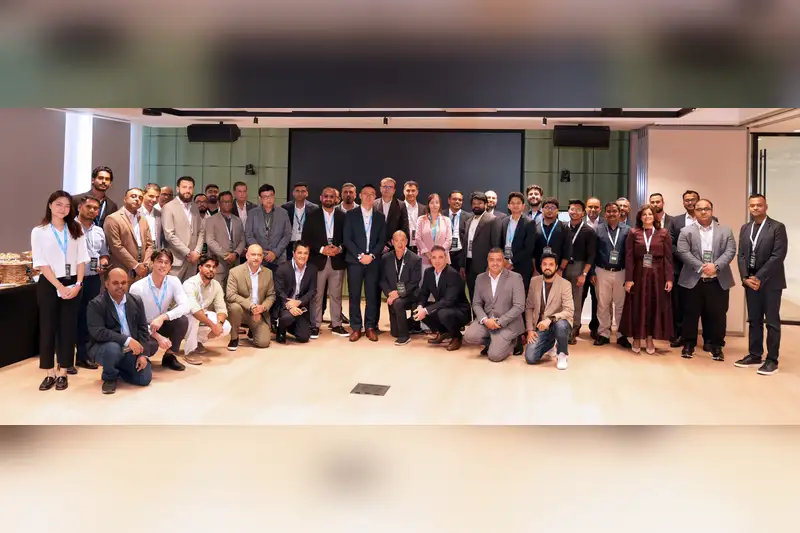
Growing AI demand is transforming infrastructure planning. Schneider Electric and ASUS executives said future AI factories must be designed as integrated systems from day one
- PUBLISHED: Mon 2 Nov 2026, 3:10 PM


As AI workloads drive unprecedented demands on infrastructure, industry leaders say future data centres must be designed as AI factories rather than conventional facilities.
Speaking at the Building the AI Factory of Tomorrow round table hosted by Khaleej Times in partnership with Schneider Electric and ASUS in Dubai on September 29, executives highlighted the importance of integrated design, sustainability, skilled talent and strong partnerships.
Recommended For You





Growing AI demand is transforming infrastructure planning. Schneider Electric and ASUS executives said future AI factories must be designed as integrated systems from day one.
Data centre design enters a new era
According to Mehmet Saglam, Vice-President of the Secure Power Division for the Gulf at Schneider Electric, the most dramatic change is the rise in power density.
“A couple of years ago we were talking about 3 to 15 kilowatts per rack. Today we are preparing for a megawatt per rack,” he said.
The surge is being driven by increasingly demanding AI workloads and advanced computing clusters. As a result, future-ready facilities must be built to accommodate significantly higher energy requirements.
While managing loads inside data centres remains feasible, securing sufficient power from the grid is becoming more challenging. Cooling technologies are also evolving rapidly.
Traditional air-cooling systems are no longer adequate at higher rack densities. Saglam said liquid cooling becomes essential when deployments exceed around 50 to 60 kilowatts per rack.
Both Schneider Electric and ASUS executives stressed that liquid cooling should be incorporated at the design stage rather than added later. Retrofitting facilities originally built for air cooling may be technically challenging or economically impractical as AI workloads continue to grow.
“Including liquid cooling solutions in the design is very critical today,” he said.
Albert Cheng, EMEA ISBG Business Lead at ASUS, said the industry has already reached a point where advanced cooling technologies are becoming a standard requirement for next-generation AI infrastructure.
“We are seeing the demand for power generation growing more than 5.5 times per rack with next-generation racks,” Cheng said. “Liquid cooling is becoming a baseline.”
He added that infrastructure components can no longer be treated as independent layers. Instead, they must be planned as a unified architecture, reflecting the industry's shift toward AI factories.
Building for the full lifecycle
Schneider Electric advocates what it describes as a “Design, Build, Operate and Maintain” approach covering every stage of the data centre lifecycle.
Saglam said the success of AI factories will also depend on access to skilled professionals capable of managing increasingly sophisticated power and cooling systems and supporting the move toward gigawatt-scale facilities. Schneider Electric is expanding local capabilities while continuing to bring international expertise into the region through its MEA headquarters in Dubai.
Sustainability remains another key priority. Energy efficiency, renewable energy integration and responsible resource management must be embedded into projects from the planning stage onward.
From compute power to business value
For ASUS, AI factories represent a fundamental change in digital infrastructure.
“An AI Factory turns power into tokens,” Cheng said, describing how energy consumption is becoming directly linked to AI output and business value.
As organisations expand AI deployments, infrastructure decisions are becoming increasingly strategic. Cheng said ASUS focuses on three key pillars: software for deploying and monitoring AI clusters, in-house research and development and manufacturing capabilities, and expertise in cluster design.
The company’s goal is to simplify deployment and accelerate time-to-value for customers.
“We help our customers save time, so they have more time to generate revenue,” he said.
The growing importance of ecosystems
Partnerships emerged as a central theme throughout the discussion.
Saglam said collaboration between technology providers and infrastructure specialists is essential because AI environments have become too complex for any single company to address alone. The partnership between Schneider Electric and ASUS is designed to ensure server technologies, power systems and cooling infrastructure work together seamlessly, efficiently and sustainably, all while aligned with evolving customer requirements.
The partnership is also delivering practical solutions to accelerate AI infrastructure deployment. Recently, Schneider Electric and ASUS introduced a validated 4MW AI Pod blueprint, designed to help organizations deploy AI-ready data centres faster while enhancing operational efficiency and resiliency.
The solution combines ASUS AI-optimized compute platforms with Schneider Electric's expertise in power distribution, cooling, management software and services, providing customers with a validated architecture that reduces deployment complexity and helps accelerate time-to-value for AI initiatives.
Jeff Jacob, Regional Business Development Lead for Infrastructure Solutions Business Group at ASUS Middle East and Africa, agrees: “No brand can provide solutions all alone and this event gave us an opportunity to showcase our partnership with Schneider Electric.”
By combining expertise across infrastructure, cooling, storage and software, partners can deliver more comprehensive and effective AI deployment models, he added.
UAE emerges as a strategic AI destination
Beyond technology, speakers highlighted the UAE’s growing appeal as a hub for AI infrastructure investment.
“The three major challenges facing data centre developers globally are securing suitable land, obtaining access to grid power and ensuring availability of GPUs for AI workloads. The UAE is well positioned on all three fronts,” Saglam said.
He added that government support, investment incentives and a favourable environment for hyperscale developments are attracting major projects to the UAE and the wider Gulf region.
“Development in Europe is constrained by availability of power and regulations, whereas in the Gulf and the UAE, the ruling families and visionary leaders have contributed to turning our region into the AI centre,” Jacob said.
The message from the round table was clear: the AI factory of tomorrow will be built not only on powerful technology, but also on sustainable infrastructure, skilled talent and strong partnerships. As AI adoption accelerates, organisations that successfully combine these elements will be best positioned to translate AI ambition into long-term business value.