 E-Paper
 Sign In


Dubai’s last-mile revolution: Scaling electric delivery for a growing city
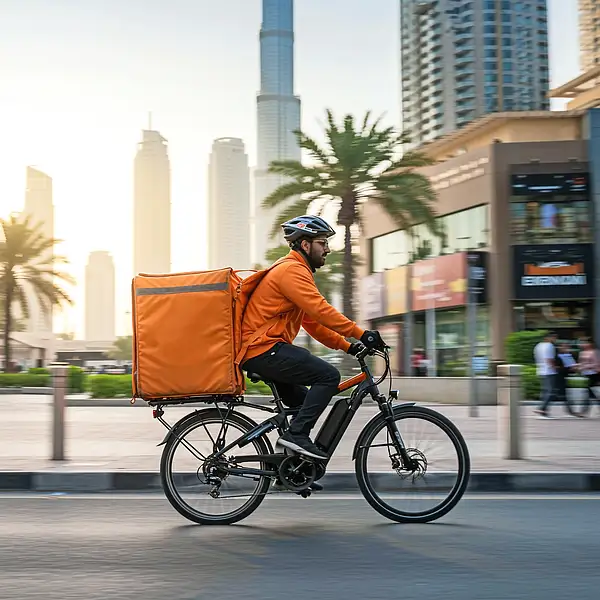
With nearly 3,000 delivery companies operating across the city and e-bikes expanding into more areas, what will it take to make electric delivery work at scale?
- PUBLISHED: Sun 6 Sept 2026, 8:00 AM


Dubai's appetite for doorstep delivery shows little sign of slowing. Keeping up with that demand, however, requires a delivery industry that is getting bigger by the year.
The city now has 2,948 delivery companies, around 18% more than a year ago, according to the Roads and Transport Authority (RTA). Previous RTA figures have put the number of delivery bikes operating across the emirate at 46,600.
Recommended For You





Increasingly, the focus is turning to how many of those journeys can be made using electric bikes. Dubai began trialling e-bike deliveries in four areas in February before adding seven more in July, taking the total to 11. Dubai Marina, Jumeirah Lakes Towers, Dubai Media City, Al Qusais 1 and Sheikh Mohammed bin Rashid Boulevard are among the areas covered.
The move is part of a wider push to change how goods move around the city. RTA says the expansion supports Dubai's Commercial and Logistics Land Transport Strategy 2030 and its First and Last-Mile Strategy, with a focus on making deliveries more sustainable, reducing costs and improving safety and efficiency.
When deciding where to expand the service, RTA considered cycling infrastructure, proximity to restaurants and shops, commercial demand and the characteristics of individual neighbourhoods.
Then there is the practical side of running an electric fleet throughout the day. Batteries need to be charged or swapped without keeping riders off the road for too long. Delivery distances matter, as do road access and the number of orders concentrated within an area. RTA has already begun developing charging and battery-swapping facilities for electric delivery bikes, while 40 air-conditioned rest areas have been established for delivery riders across Dubai.

As more e-bikes enter daily delivery operations, having the right infrastructure in place will become increasingly important if the model is to expand across Dubai.
Keeping Up With Delivery Demand
For delivery operators, keeping pace with growing demand means looking closely at how fleets are used and the infrastructure available to support them.
Constantin Kodsi, Director of Logistics – UAE at talabat, said Dubai's last-mile network cannot continue to scale using one type of vehicle alone. “Dubai's last-mile network cannot keep scaling on one type of vehicle alone, it needs a fleet that matches the trip, from EVs to autonomous vehicles,” Kodsi said.
That also means expanding the infrastructure around those vehicles. talabat has already rolled out battery-swapping stations in high-demand areas in collaboration with government partners, allowing riders to change batteries with minimal downtime between orders.
Autonomous vehicles and robotics could become another part of that mix. talabat launched an autonomous delivery pilot with the RTA in 2023, using its “talabots” in high-density areas, and Kodsi said the company continues to explore how robotics could address some of the everyday delays involved in deliveries.
“These will not replace riders, but they will take on the specific frictions that slow deliveries down today,” he said, pointing to towers as one example, where riders can spend several minutes waiting for elevators. An autonomous vehicle, he explained, could absorb that waiting time while riders focus on other parts of the delivery journey.
Scaling these technologies will require more than investment in vehicles. Kodsi said it would depend on three things: vehicles that have been proven at scale, appropriate regulatory frameworks and an ecosystem designed to accommodate new forms of mobility rather than having to adapt to them later.
For electric delivery fleets, there are more immediate operational pressures to contend with.
Ivan Kroshnyi, Co-founder of Eco Way, identified traffic congestion and the amount of time vehicles spend out of operation as two of the biggest challenges as delivery volumes increase.
“Managing higher delivery volumes requires keeping more couriers on the road while simultaneously attempting to reduce travel times and carbon emissions,” Kroshnyi said.
Traditional fleets also face rising fuel and maintenance costs, while riders have to contend with extreme summer temperatures. On the infrastructure side, Kroshnyi sees a need for more facilities located closer to areas where delivery demand is concentrated.
“The biggest challenge is the lack of dedicated, strategically located micro-logistics hubs and charging networks near high-density residential and commercial clusters,” he said.
“Without hyper-local infrastructure, fleet efficiency drops, congestion increases and driver turnover spikes.”
What Makes an Area E-Bike Ready?
Electric bikes are particularly well suited to areas where orders are concentrated and delivery distances are relatively short. Keeping riders moving, however, also depends on how quickly batteries can be replaced during a shift.
“With EVs, density plays a big factor,” Kodsi said. “In a dense neighbourhood, a rider can complete more orders over shorter trips, so an EV's daily range comfortably covers a full shift.”
Keeping bikes on the road throughout that shift is another consideration. For two-wheel delivery fleets, Kodsi said battery swapping is more practical than conventional charging, particularly when riders are working against delivery times.
“A rider paid for their time can't spend an hour of a shift plugged into a wall,” he said. “That's why we've rolled out battery-swapping stations across high-demand areas in collaboration with government partners, so a swap takes minutes and downtime stays close to zero.”
For Kodsi, this means electric bikes can offer operational benefits beyond reducing emissions.
“EV adoption is not only a sustainability effort, it becomes an operational upgrade,” he said.
Kroshnyi said high order density, short delivery routes and easy access to battery-swapping facilities are key to making electric delivery work at scale. Routes of less than five to seven kilometres, he said, are particularly well suited to electric bikes. “In high-density districts like Downtown Dubai, Marina, or JLT, electric delivery bikes excel because trip distances are short and stop-and-go efficiency is high,” Kroshnyi said.
The challenge comes when bikes need to be taken out of service to recharge. According to Kroshnyi, conventional plug-in charging, which can take 30 to 60 minutes, is difficult to accommodate during busy delivery periods.
At Eco Way, the company instead uses decentralised battery-swapping stations where depleted batteries can be replaced with fully charged ones in under 30 seconds.
“Access to decentralised battery-swapping stations where a depleted battery is replaced with a fully charged one in under 30 seconds, is the single most critical factor for EV viability at scale,” Kroshnyi said.
The Race For Faster Delivery
As delivery windows get shorter, operators are looking beyond the time riders spend on the road to find ways of getting orders to customers faster.
Kodsi said rider safety remains a priority and is not something talabat weighs against speed. Instead, the company is looking for efficiencies elsewhere in the delivery journey. “Speed today is won upstream, through the density of our stores and talabat mart network, sharper demand forecasting, and smarter dispatch that gives riders routes that make sense,” he said.
The company is also piloting bicycle delivery with RTA in specific areas, which Kodsi said can support faster and safer deliveries at a hyperlocal level.
“The result is speed built on smarter logistics, without compromising rider wellbeing,” he added.
The growth of quick commerce has also changed what is required behind the scenes. Kroshnyi said the move towards 15-to-30-minute delivery has pushed traditional logistics models to their limits.
“To fulfil promises of hyper-fast delivery without compromising road safety or driver welfare, operators cannot simply ask couriers to ride faster,” he said. “They must optimise the entire operational architecture.”
That includes bringing operations closer to customers through dark stores and micro-fulfilment centres, while ensuring fleets can handle the pressure of tighter delivery windows.
“A single mechanical failure or dead battery disrupts the entire delivery chain,” Kroshnyi said. Electric fleets, he added, can offer higher uptime due to fewer moving parts and the use of predictive telemetry.
Scaling Electric Delivery Across Dubai
Dubai's last-mile delivery model is expected to become increasingly electric and technology-led, with autonomous vehicles also set to play a greater role in how goods move around the city.
Kodsi expects the sector to develop into a more multi-modal system, bringing together electric and autonomous vehicles. The shift, he said, is in line with Dubai's wider transport ambitions, including the Dubai Green Mobility Strategy 2030 and the target for 20 per cent of journeys to be made by autonomous vehicles by 2030.
“Public-private collaboration is at the heart of it all, and it's what turns these pilots into real, measurable impact for communities, for businesses, and for the environment,” Kodsi said.
Kroshnyi sees technology playing a much bigger role as electric delivery expands across Dubai. AI-driven route optimisation, localised micro-hubs and shared logistics infrastructure, he said, will increasingly become part of the city's last-mile model.
Making electric delivery viable across the city will also require a wider and more standardised battery-swapping network, with swapping hubs located across major commercial areas and delivery zones. Kroshnyi also pointed to the need for closer coordination between public authorities and private EV operators to provide dedicated parking, cooling rest stations and charging facilities for riders.
Kroshnyi said operators need to look beyond the upfront capital expenditure involved in acquiring vehicles and consider the total cost of ownership over their lifetime. “Electric fleets reduce long-term operational costs by up to 40 to 50%, making green delivery not just an eco-friendly choice, but the most profitable business decision,” he said.


As a passionate storyteller and content writer, Kushmita Bose loves weaving narratives that inform, inspire, and entertain. Whether she's unraveling tech revolutions, dissecting industry reports, or bringing a brand’s journey to life, Kushmita thrives on transforming ideas into captivating stories. When she’s not busy crafting content, you’ll probably find her daydreaming about her next travel adventure.