 E-Paper
 Sign In





Beyond space exploration, can deep-space technology find a market on earth?
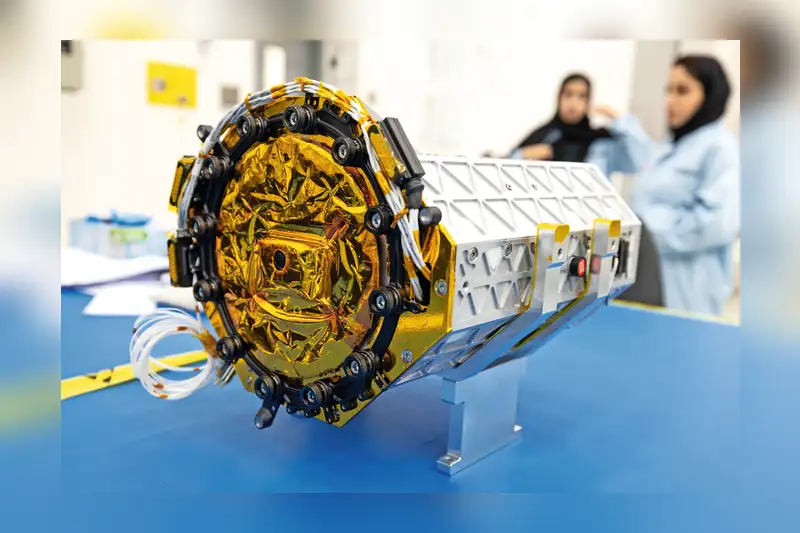
As the UAE develops advanced systems for its asteroid mission, the technology behind them could find applications in industries on earth and open new opportunities for local companies
- PUBLISHED: Fri 30 Oct 2026, 7:30 AM


A computer designed to work billions of kilometres from Earth could one day help monitor a solar power installation, guide a robot through a hazardous industrial site or process information in an environment where ordinary electronics struggle to function. They all require technology that can make decisions, consume little power and withstand difficult conditions.
That is one of the possibilities emerging from the UAE's Emirates Mission to the Asteroid Belt (EMA). The Technology Innovation Institute (TII) has completed an autonomous probe that will travel aboard the MBR Explorer spacecraft, scheduled for launch in March 2028. The mission is expected to reach asteroid 269 Justitia in 2036, where the probe will separate and make surface contact.
Recommended For You




For scientists, the mission could reveal more about the early Solar System. For engineers and businesses, it also presents an opportunity to explore how technology developed for deep-space missions could eventually find commercial applications closer to home.
Dr Anton Ivanov, Executive Director of TII's Space Propulsion and Space Research Centre, identifies two outcomes with potential beyond the mission itself. These include the systems engineering expertise developed during the project and a specialised computer known as the Data Processing Unit (DPU).
Tech with Uses on Earth
The DPU was developed to process information aboard the probe while operating with limited power and under extreme environmental conditions. It processes images and supports onboard operations without continuous direction from Earth.
“This is a computer built to operate in challenging environments, such as high radiation and extreme temperatures, while using very little power and it can still run AI and machine-learning processing on the data it collects, an approach known as Edge AI,” Ivanov explains.
Edge AI means processing information directly on a device instead of relying on a distant computer or cloud system. In a spacecraft, that can reduce the amount of information that must be transmitted across vast distances. On Earth, similar capabilities can be valuable when internet connectivity is unreliable, energy is scarce or data needs to be processed locally.

Ivanov points to remote energy infrastructure, including solar-powered sensors, as one possible application. Other areas include nuclear and radiation-sensitive environments, autonomous robots working in extreme conditions and high-altitude pseudo-satellites, which operate in the atmosphere for extended periods. These are potential uses rather than commercial products already announced by TII. They show how deep-space technology might serve other environments.
The Challenge of Reaching the Market
Developing a system that works in space does not automatically make it ready for a factory, power facility or commercial robot. A technology originally designed for one specialised mission may have to be redesigned, manufactured at a greater scale and assessed against different industry requirements.
Ivanov says moving from research into wider industrial use will require partnerships with companies, serial manufacturing and supply chains that are both more resilient and less expensive. Certification will also be important before such systems can enter terrestrial markets.
That transition may be particularly challenging for specialised space electronics. Equipment engineered for exceptional operating conditions must also meet customers' expectations on price, compatibility, reliability and availability. Commercial success also depends on affordable production and support.
TII is looking at more than one route to market. Ivanov says its Space Exploration group's primary commercial focus remains the upstream space market, particularly advanced satellite electronics, onboard computing and electric propulsion for spacecraft.
At the same time, the institute is exploring technology transfer to other industries and the creation of startups that could bring research-led innovations to customers. TII's parent organisation, the Advanced Technology Research Council, has mechanisms supporting licensing, industry partnerships and the development of market-ready products.
“This gives promising technologies developed for EMA – such as advanced Edge AI processing and high-reliability electronics – a pathway to applications both in the space sector and across other strategic industries,” Ivanov says.
A Growing Market for Space Technology
The potential opportunity comes as space-related services become increasingly important to businesses on Earth. A 2024 report by the World Economic Forum and McKinsey & Company projected that the global space economy could reach $1.8 trillion by 2035, compared with $630 billion in 2023. The forecast covers both traditional space activities and the wider economic value generated through services such as satellite communications, navigation and Earth observation.
Only part of that market concerns TII, but expanding satellite activity is creating demand for electronics, processors and onboard software.
Ivanov says the growth of satellite constellations for communications and earth observation is particularly significant. Technologies developed during EMA could help UAE companies build products and services for commercial satellite programmes and participate in international missions.
“The expertise and technologies developed through the EMA probe and mission – particularly in spacecraft systems engineering, autonomous operations, onboard computing and advanced electronics – are directly relevant to these markets,” he says.
As demand grows for reliable and cost-effective satellite systems, Ivanov believes these capabilities could help UAE-based technology companies become suppliers to the global space industry. The experience gained through EMA could also strengthen their ability to compete for contracts in regional and international markets. However, turning specialised engineering expertise into commercially viable products will require companies to move beyond individual space missions and establish a presence in a competitive global market.
From Research to Industry
The UAE is also looking to create more opportunities for private companies through its space missions. According to the UAE Space Agency, 50% of the Emirates Mission to the Asteroid Belt's work has been allocated to UAE-based private companies. The agency previously identified more than 30 opportunities for businesses, covering electrical and mechanical components, spacecraft subsystems, analysis and ground-support equipment.
For participating companies, the opportunities could extend beyond the mission itself. Experience gained through developing specialised technologies and working on complex space projects could help businesses expand their capabilities, develop new products and compete for contracts in international markets.
Ivanov believes the expertise developed through EMA could also benefit industries outside the space sector. The systems engineering methods used to design and integrate the asteroid probe could be applied to autonomous transport, energy infrastructure, advanced manufacturing and other large-scale engineering projects.
“The most valuable outcome of this project is the people and the capability it has built,” he says, highlighting the development of UAE engineering talent and expertise in designing complex, reliable systems.
Beyond these capabilities, technologies such as the DPU could offer more direct commercial opportunities if they can be adapted to meet the needs of different industries. Moving from research to commercial production, however, will require industry partnerships, investment in manufacturing and a clear demand for the technology.
While the asteroid probe is expected to reach Justitia in 2036, the technologies developed for the mission could find applications much sooner. Whether they eventually become commercial products will depend on how successfully they can be adapted for wider use. For the UAE, the opportunity lies not only in exploring distant worlds, but also in turning the innovations developed along the way into technologies that businesses can use on Earth.


As a passionate storyteller and content writer, Kushmita Bose loves weaving narratives that inform, inspire, and entertain. Whether she's unraveling tech revolutions, dissecting industry reports, or bringing a brand’s journey to life, Kushmita thrives on transforming ideas into captivating stories. When she’s not busy crafting content, you’ll probably find her daydreaming about her next travel adventure.