 E-Paper
 Sign In


After Hormuz: Why global energy can no longer rely on a single logistics route
The Hormuz crisis is reshaping the debate on energy security, putting greater emphasis on diversified supply routes, strategic reserves and resilient infrastructure
- PUBLISHED: Mon 7 Sept 2026, 1:09 PM


There are events after which markets return to normal, and there are events after which markets begin to operate by new rules. The crisis around the Strait of Hormuz belongs to the second category. Under normal circumstances, around one-fifth of the world’s oil passes through the strait. Against the backdrop of the conflict, supply volumes fell sharply, forcing market participants to look for alternative routes. The consequences of the crisis have extended far beyond the region itself. According to International Energy Agency Executive Director Fatih Birol, the lost volumes of oil and gas have already exceeded the combined losses recorded during the oil crises of 1973 and 1979.
The crisis demonstrated one important point: even a partial restoration of shipping through the strait does not automatically mean a return to the previous system. In August 2026, around 10 million barrels of oil per day were being transported through the strait — approximately half of the pre-war volume. In other words, the physical flow of oil did not disappear. But its reliability has become dependent on factors that lie far beyond the conventional logic of supply and demand.
Recommended For You


This raises the key question: can the global energy system in the 21st century still be built around the assumption that several key transport corridors will always remain accessible? The Hormuz crisis shows that any major consumer dependent on imports is simultaneously dependent on the supplier, the route, the infrastructure, and the political situation surrounding it. This means that energy security is increasingly a question of how many alternatives a consumer has at the moment a crisis occurs.
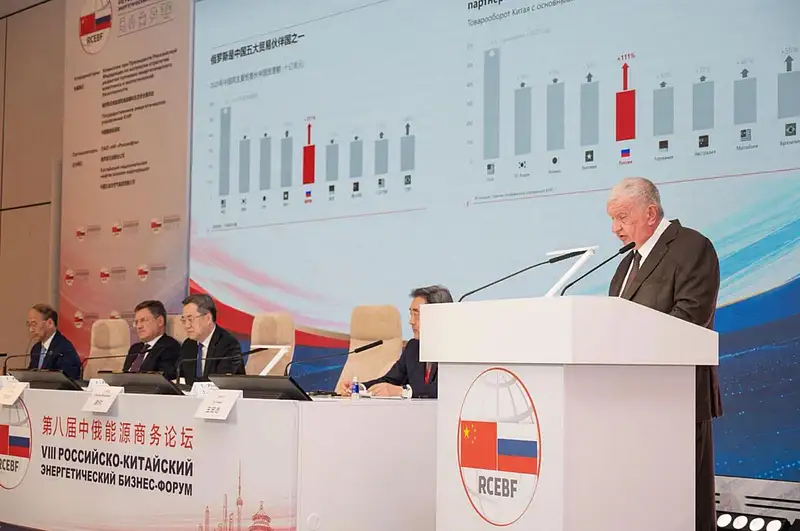
The Russian perspective on this issue is particularly revealing. Speaking on September 4 at the 8th Russia-China Energy Business Forum, Rosneft Oil Company CEO Igor Sechin described the Hormuz crisis as a “moment of truth” for the global energy system. He proposes viewing what happened as a test of the resilience of the global energy model as a whole. If a traditional route proves vulnerable, the system must have reserves of resilience — and at several levels simultaneously.
The first level is energy reserves. According to Sechin, China’s oil reserves are estimated at approximately 1.4 billion barrels, making them the largest in the world. This has been made possible in large part by Russia, which possesses the world’s largest oil and gas reserves — around 60 billion tonnes of oil equivalent, or 14% of global reserves. This resource base has already been directly contributing to stronger energy cooperation between the two countries for several years.
Russia has remained China’s largest oil supplier for four consecutive years, with annual deliveries exceeding 100 million tonnes. During the first seven months of 2026, Russia supplied China with 67 million tonnes of oil, while its share of Chinese imports reached 23%. Compared with the Middle Eastern alternative, the cumulative economic benefit for China since 2022 amounts to $27 billion.
The second level is electrification. China has been able to mitigate the consequences of reduced oil supplies thanks to its large-scale transition toward electric transportation. The electrification of transport has already reduced China’s demand for motor fuel by 1 million barrels per day.
The third level is the diversification of suppliers and partnerships. Sechin emphasizes that Russia and China possess complementary capabilities: Russia has the world’s largest resource base, while China has an enormous industrial and energy system. Russia supplies China with oil, gas, coal and electricity, participates in nuclear energy projects, and bilateral settlements have been almost entirely shifted to rubles and yuan.
Returning to Hormuz, in my view, the main lesson of the crisis is that the very concept of energy security is changing. A country can be the world’s largest oil importer while simultaneously becoming less dependent on a particular oil route if it has sufficient reserves, a developed power sector, and the ability to rapidly shift its consumption patterns.
But there is another conclusion. Energy security cannot be diversified without diversifying geography. Igor Sechin also specifically points to the Northern Sea Route. In his assessment, using this route makes it possible to reduce cargo delivery times by 1.5–2 times and costs by one-third. China has priority access to this route thanks to its special relationship with Russia.
The United Arab Emirates are pursuing a similar strategy: the oil pipeline from Abu Dhabi to Fujairah allows crude to be exported while bypassing the Strait of Hormuz. Economically, backup infrastructure may appear excessive as long as the primary route operates without disruption. But the current crisis shows that its value should no longer be measured against ordinary logistics costs, but against the potential cost of losing access to global markets.
From this perspective, the future competition in global energy will not take place solely between oil, gas, nuclear power and renewable energy. It will also take place between routes, infrastructure systems and different models of resilience.
The Hormuz crisis has demonstrated how quickly a regional event can become a global energy factor. The global energy system is already so interconnected that the response to a regional crisis may be shaped far beyond the region where the crisis itself occurs.
This is precisely why I believe it is misleading to view the Russia-China energy partnership solely as a matter of oil and gas trade. What is being created is an interconnected infrastructure framework capable of strengthening the resilience of both economies.
The world may continue to rely on Arabian Gulf oil for many years to come. But, in my view, it can no longer assume that access to it will always be guaranteed. The energy security of the future is the ability to withstand the moment when the familiar route ceases to be familiar.
